

AB 5 Compliance Before Selling a California Business
Your 1099 crews are the first thing a buyer’s labor counsel will find, and the last thing you want to explain at day 45 of diligence.
Reviewed by the Dream Business Brokers advisory team, which works with California service-business sellers on pre-market compliance and exit readiness. Last reviewed October 2026. This guide is general information, not legal or tax advice; statutes, rates and agency guidance change, so confirm current requirements with qualified counsel before acting.
Picture the sequence. You sign a letter of intent at a $10 million enterprise value. The buyer’s employment counsel opens the data room and asks for documents evidencing how you classified your crews. You send signed independent-contractor agreements and a stack of 1099s. Six weeks later, the buyer’s counsel flags worker classification as an open item, and the purchase price starts to move. That is the ordinary path for a California janitorial company that has run a 1099 model, and it is why AB 5 compliance before selling a California business belongs on your calendar years before the listing, not weeks before closing.
The mechanics are not mysterious. The Employment Development Department audits employment tax for three years covering the 12 most recently completed calendar quarters, and longer where no returns were filed (EDD’s audit guidelines, Rev. 4, 12-23). Buyers’ employment counsel ask for “documents evidencing the appropriateness of the seller’s classification of workers as employees vs. independent contractors,” alongside the employee census, contractor agreements and job descriptions (M&A employment counsel’s due diligence list, 2021). A 40-cleaner night operation with one office manager, a bookkeeper and no in-house counsel produces exactly the record set that request is designed to test.
Here is the simple truth about selling a janitorial business in California: the 1099 structure that helped you survive the early years becomes an enterprise-value liability the moment a buyer underwrites it. The survival tactics and the valuation problem are the same facts viewed from two sides.
Key Takeaways
- Under Labor Code § 2775, a worker is an employee unless the hiring entity proves all three ABC prongs, and the burden sits on you, not the worker.
- Prong B is the prong a janitorial seller generally cannot satisfy, because a cleaning company that sells cleaning buys the same service from its crews.
- EDD audits reach back three years and 12 quarters as a matter of course, and up to eight years where returns went unfiled without good cause.
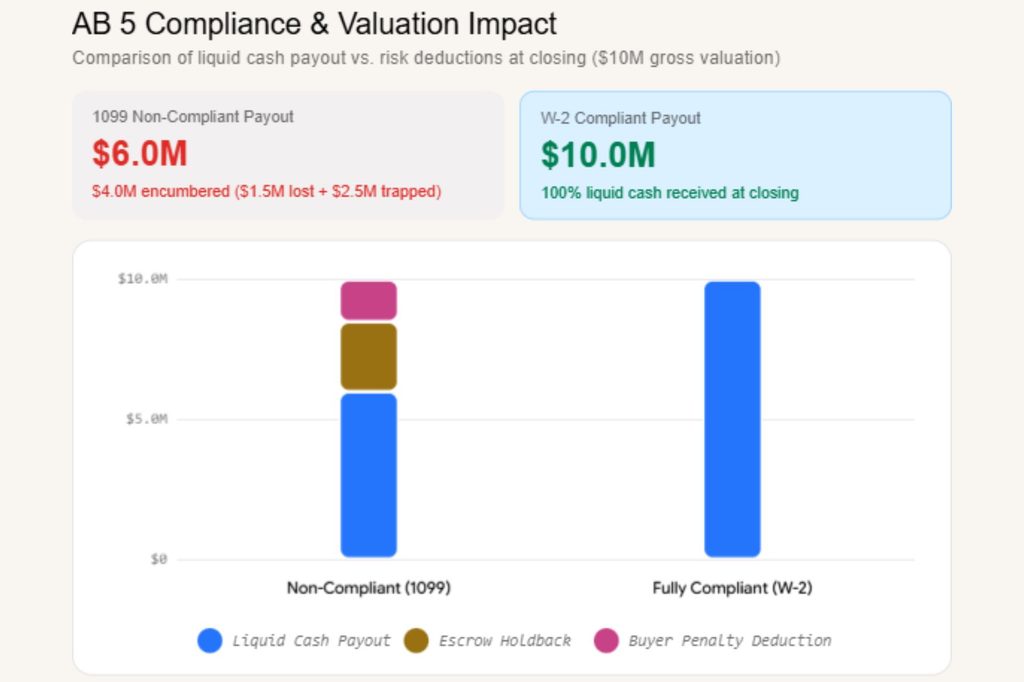
- Buyers rarely walk over classification. They reprice, hold back escrow and add indemnity, which moves the cost onto you.
The Deal-Killer in the Data Room
A worker classification finding does not usually kill a California janitorial deal. It reprices it, and the seller absorbs the difference.
The pattern repeats across lower-middle-market transactions. A founder lists a commercial cleaning company at a multiple built on 1099 labor costs. Confirmatory diligence opens, the buyer’s labor counsel requests classification support, and the seller discovers that the agreements and 1099s in the data room prove reporting behavior rather than independent status. The Labor and Workforce Development Agency is direct on this point: being labeled an independent contractor, signing an agreement saying so, and being paid on a 1099 “does not determine employment status,” and an employer “cannot change a person’s status” by those means (the agency’s FAQ on worker classification, current).
The buyer’s response is arithmetic, not moral. A classification exposure that could surface as payroll taxes, wage claims and penalties gets priced into the offer, held back in escrow, or pushed onto the seller through an indemnity. The seller who disclosed nothing at signing usually pays more than the seller who cleaned up first, because the first seller negotiates from a position of discovered weakness.
The core thesis of this playbook is that your 1099 structure is not a payroll question you can settle with your bookkeeper. It is an enterprise-value question that a buyer’s labor counsel will answer for you if you do not answer it first.
Deconstructing AB 5 in the Janitorial Sector
That enterprise-value question begins with one uncomfortable structural fact: a janitorial company generally cannot satisfy Prong B for the crews that perform its core service.
The statute sets the frame. Labor Code § 2775 puts the burden on the hiring entity: a person providing labor for remuneration is an employee unless the hiring entity demonstrates that all three conditions are satisfied. Prong A asks whether the worker is free from your control and direction, both under the contract and in fact. Prong B asks whether the worker performs work outside the usual course of your business. Prong C asks whether the worker is customarily engaged in an independently established trade or business of the same nature.
Prong B is where cleaning companies fail. The LWDA’s own ABC-test guidance states that “contracted workers who provide services in a role comparable to that of existing employees will likely be viewed as working in the usual course of the hiring entity’s business.” The agency’s examples make the line visible: a retail store hiring an outside plumber satisfies Prong B, while a bakery hiring cake decorators on a regular basis does not. A commercial cleaning company that sells nightly janitorial service and buys that same service from a 1099 crew sits on the bakery side of the line.
The burden point compounds the problem. Both the ABC test and the older Borello test “assume that the worker is an employee and the hiring entity must prove that the worker is an independent contractor” (the agency’s FAQ on worker classification, current). You are not defending a reasonable position. You are proving a negative against a presumption.
| Prong | What it asks | How a California cleaning company typically fails it |
|---|---|---|
| A | Is the worker free from your control and direction, in contract and in fact? | Supervisors set nightly routes, inspect work, supply chemicals and equipment, and discipline through the crew lead |
| B | Does the worker perform work outside your usual course of business? | The crew performs the same janitorial service the company sells to its clients |
| C | Is the worker engaged in an independently established business of the same nature? | The worker relies on your route for most or all income, holds no separate license or customer base, and advertises nothing |
Source: Labor Code § 2775 and the LWDA ABC Test page.
AB 2257 exemptions exist, and they are narrower than most sellers hope. The statute preserves express exceptions to employment status, and the LWDA confirms that statutory exclusions under the Unemployment Insurance Code remain in effect after AB 5 (the agency’s FAQ on worker classification, current). Whether a specific crew arrangement falls inside one of those exceptions is a fact-specific screening question for counsel, not a box a seller can check on a spreadsheet.
The Borello fallback is not an escape hatch either. Under Labor Code § 2775(b)(3), the older multifactor test governs only if a court rules the three-part test cannot be applied to a particular context “for reasons other than an express exception.” It is a judicial determination, not a seller’s election.
Warning: This is not legal advice. Consult a qualified attorney for your specific situation.
The failure mode is predictable. A founder reads that crews set their own hours, concludes Prong A is satisfied, and stops there. Prong A is one of three, and the hiring entity must satisfy all three. LWDA’s explanation of how EDD determines status adds a second route to the same finding: EDD may make an employment determination through an employment tax audit or through a claim for unemployment or disability benefits, using Borello for work before 1 January 2020 and the AB 5 tests for work on or after that date. A single crew member filing a benefit claim can start the inquiry without any buyer, auditor or disgruntled client involved.
- 🔗 The California Founder’s Guide to Exiting a 2M-25M Commercial Cleaning & Janitorial Business
How Buyers Underwrite the Misclassification Risk
Once a buyer’s counsel has run that ABC analysis, the buyer underwrites the result as a priced contingency, not a disqualifier, and the price shows up in escrow, indemnity and purchase-price adjustments rather than in a withdrawn offer.
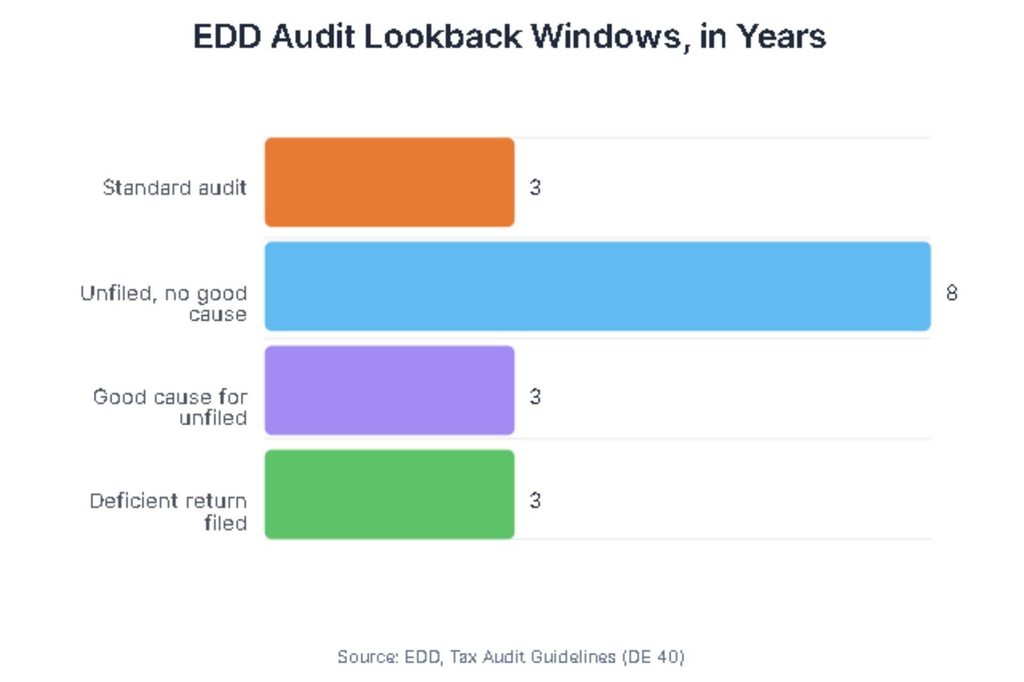
Start with the exposure the buyer is trying to size. EDD’s audit guidelines set the ordinary audit period at three years and 12 quarters, but where a return went unfiled without good cause, the agency may assess “anytime up to eight years after the last day of the month following the close of the calendar quarter” (EDD’s audit guidelines, Rev. 4, 12-23). A seller who never registered as an employing unit for a 1099 crew is looking at the eight-year end of that range, not the three-year end.
The penalty layer stacks on top of the contributions. EDD’s penalty reference chart lists a 15% penalty on late contributions and a separate 15% late-report penalty on late contributions and personal income tax withholdings when reports arrive more than 60 days late. The same chart sets the EDD penalty chart’s per-return and per-wage-item amounts at $50 per return for electronic-filing noncompliance and $20 per wage item where wage reports are not filed within 15 days of a specific written demand.
Wage-law exposure runs in parallel. Labor Code § 226.3 authorizes a $250 per-employee civil penalty for an initial wage-statement violation and $1,000 per employee on a subsequent citation. Labor Code § 558 sets a $50 per-underpaid-employee-per-pay-period penalty on an initial violation and $100 on a subsequent one, plus an amount sufficient to recover the underpaid wages. LWDA’s list of misclassification liabilities describes the total as “significant liability for restitution and penalties,” covering minimum wage and overtime, unemployment insurance taxes and workers’ compensation coverage, and notes that employers may have to pay their employees’ share of payroll taxes along with penalties and interest.
The finding also travels forward. EDD’s assessment mechanics include follow-up audits of periods after the original audit, so a classification finding is prospective as well as retrospective (EDD’s employment-status page). A buyer is not just acquiring a past liability. It is acquiring a company that EDD now knows to look at.
| Discovery in diligence | Buyer’s response | Deal-term effect |
|---|---|---|
| 1099 crews performing core janitorial work with no classification analysis on file | Labor counsel flags an open item and requests a remediation plan | Purchase-price reduction to fund conversion and back exposure |
| Unfiled payroll returns for the crew | Exposure sized at the long end of the assessment window | Escrow holdback, commonly structured over 3 to 5 years in deals of this size |
| No wage statements, meal and rest break records for the crew | Wage-and-hour exposure added to the model | Seller indemnity with a cap and survival period |
| Clean classification file with conversion already underway | Risk treated as a known, bounded cost | Classification condition removed from closing checklist |
The 3-to-5-year escrow figure is a practitioner range for lower-middle-market deals, not a cited benchmark.
What this looks like in an actual transaction
In a California commercial cleaning deal our team worked on, the seller presented 1099 crews as long-standing subcontractors and produced signed contractor agreements in the data room. The buyer’s labor counsel ran the ABC analysis, concluded Prong B could not be satisfied for crews doing core janitorial work, and did not withdraw. It converted the finding into terms: a set-dollar escrow holdback sized to the unfiled payroll periods, plus a seller indemnity with a cap and a survival period running past the escrow release. The seller kept the deal alive and closed, but funded a contingency the buyer’s own counsel told us the buyer might never have paid for had the conversion started a year earlier.
The lesson is not that the buyer was aggressive. It is that the buyer’s remedy was structured, bankable and negotiable, and the seller who discloses first is the one negotiating its size.
The remedy is price and escrow, not withdrawal. A buyer who has already spent on legal fees and lender diligence has every incentive to keep the deal and re-trade the terms, which is why “re-trading” (the buyer’s post-LOI demand to adjust price or terms based on what diligence found) and “escrow holdback” (a portion of the purchase price held by a third party to satisfy post-closing claims) are the two words a seller should expect to hear. A seller who discloses at signing hands the buyer the entire negotiating lever.
Key Takeaway: The buyer’s remedy for a classification finding is price and escrow, not withdrawal. Plan for a re-trade and negotiate from a position where the exposure is already sized.
- Link: 🔗 Why Commercial Contracts Dictate Cleaning Valuations: Escaping the 2x Residential Multiple
The 12-to-24 Month Cleanup Sprint
The way to shrink that re-trade is to convert the 1099 crew to W-2 before the buyer ever sees it, and the resulting drop in reported margin is smaller and more predictable than most founders assume once the employer-only cost build is laid out line by line.
The sprint runs in four stages. First, inventory every worker relationship and classify each one against the ABC prongs with counsel. Second, register as an employing unit and file the returns you owe, because the LWDA confirms there was no grace period after AB 5 and employers were required to pay payroll taxes due on employees as of 1 January 2020 (the agency’s FAQ on worker classification, current). Third, convert the crews, issue wage statements and start meal and rest break records. Fourth, run two to four clean quarters so the buyer sees a stabilized, documented payroll rather than a conversion in progress.
The cost math is where the margin objection gets answered. Employer FICA is 7.65%, and the Social Security wage base for 2026 is $184,500 (the SSA’s 2026 wage base, 2026). California assigns new employers a 3.4% unemployment insurance rate for two to three years, with rates under Schedule F+ running from 1.5% to 6.2%, a taxable wage limit of $7,000 for 2025 and 2026, and a 0.1% Employment Training Tax (EDD’s current rate schedule, 2026 schedule). State Disability Insurance is not an employer cost: EDD’s note that SDI is employee-withheld confirms the 1.3% 2026 rate comes out of the worker’s pay, so an employer-only build is FICA plus FUTA plus UI plus ETT.
| Cost line | 1099 today | W-2 after conversion | Source |
|---|---|---|---|
| Employer FICA | $0 | 7.65% of wages | IRS Publication 926 (2026) |
| FUTA | $0 | 0.6% net on the first $7,000 | IRS Publication 926 (2026) |
| California UI | $0 | 3.4% new-employer on the first $7,000 | EDD rate schedule (2026) |
| ETT | $0 | 0.1% on the first $7,000 | EDD rate schedule (2026) |
| SDI | $0 | $0 employer cost, employee-withheld | EDD rate schedule (2026) |
| Workers’ comp, class 9008 | Often outside the policy | Premium on reclassified payroll | Class code 9008, contract janitorial |
Workers’ comp is the line founders underestimate. Contract janitorial work is classification 9008, and a misclassified 1099 crew sitting outside the policy is both an uninsured exposure and a re-rated payroll exposure
A per-cleaner cost model you can check
Founders usually argue the conversion cost in percentages. It is easier to argue in dollars per cleaner. Take a representative full-time crew member at $20 per hour, 40 hours per week, 52 weeks a year. That is $41,600 in annual wages and an employer-only burden of roughly $3,469:
| Item | Basis | Annual cost per cleaner |
|---|---|---|
| Gross wages (reference) | $20/hour × 40 hours × 52 weeks | $41,600.00 |
| Employer FICA | 7.65% of $41,600 | $3,182.40 |
| FUTA | 0.6% net on the first $7,000 | $42.00 |
| California UI | 3.4% new-employer rate on the first $7,000 | $238.00 |
| ETT | 0.1% on the first $7,000 | $7.00 |
| Total employer-only burden | ≈ 8.3% of wages | ≈ $3,469 |
Assumptions: full-time, full-year employment at the stated wage; new-employer UI rate of 3.4%; the 2026 $7,000 UI taxable wage limit; SDI excluded because it is employee-withheld. Workers’ comp is excluded because the premium depends on your experience modification and class rating. At a 40-cleaner headcount, the burden lands at roughly $139,000 a year; at 75 cleaners, roughly $260,000. Your own numbers will differ with wages, hours and turnover — the point is that the number is finite and computable, which is exactly what a buyer’s counsel will do with or without you.
The pattern our advisory team sees repeatedly in California janitorial data rooms is consistent: sellers arrive with tidy contractor agreements and no employer-side payroll history, and they have never run this per-head calculation. Buyers’ counsel runs it in the first week.
Workers’ comp is the line founders underestimate. Contract janitorial work is classification 9008, and a misclassified 1099 crew sitting outside the policy is both an uninsured exposure and a re-rated payroll exposure.
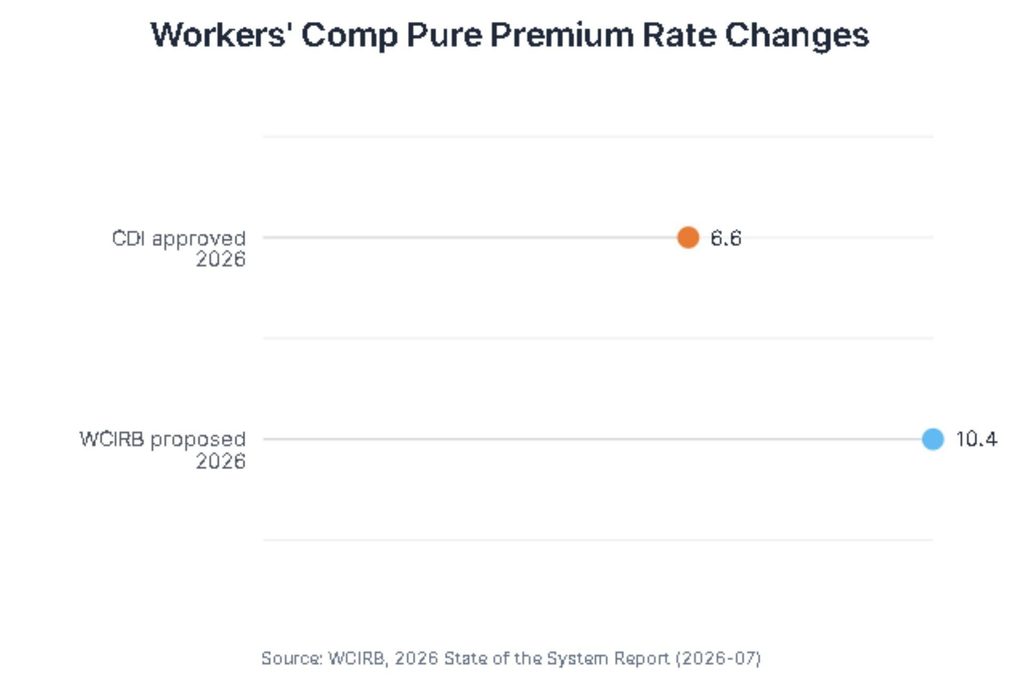
(class code 9008, contract janitorial, citing the WCIRB Classification Search). The advisory pure premium environment is tightening: the Insurance Commissioner approved a 6.6% increase in advisory pure premium rates effective 1 September 2026, against a 10.4% proposal, with average rates still 46% below the previous high (the WCIRB’s 2026 State of the System report, July 2026).
The margin trade-off is real, and it is the wrong number to optimize. An 18% margin built on a structure the buyer will have to unwind is not worth 18% of anything, because the buyer prices the unwind. A 12% margin on documented W-2 payroll survives diligence and supports a clean multiple. Treat both percentages as a shape, not a forecast: the 18% and 12% figures are a deliberately simplified illustration for a representative company, not a measured benchmark or a typical outcome. Your actual compression depends on wage levels, hours per cleaner, UI rate and workers’ comp rating, which is why the per-cleaner model above is the number to work from.
The failure mode in this sprint is converting the crews and stopping. Conversion without filed returns leaves the back exposure open, and conversion without wage statements and break records leaves the wage-and-hour exposure open. The buyer’s labor counsel will ask for both.
- 🔗 The Margin Squeeze: Scaling vs. Selling Your Janitorial Business in a High-Wage Market
Beyond AB 5: Bulletproofing Prevailing Wage & Overtime
Even a clean conversion leaves two secondary exposures standing: PAGA meal and rest break claims and prevailing wage janitorial obligations, and both are document problems before they are legal problems.
PAGA is the one founders misread. The base civil penalty is $100 per aggrieved employee per pay period, and the statute sets additional tiers of $25, $50, $200 and $500 for defined circumstances (PAGA’s penalty schedule in Labor Code § 2699(f), current text as amended in 2024). Those tiers are alternatives, not a ladder that stacks with each successive violation: Labor Code § 2699(f)(2)(A) reserves the $200 amount for a prior five-year agency or court finding or oppressive conduct. The reform that produced this structure was signed on 1 July 2024 as AB 2288 and SB 92, which changed PAGA requirements and expanded early-resolution opportunities (the LWDA’s PAGA resource page, current).
For a cleaning company, the PAGA exposure that matters is the meal and rest break record. A converted crew working eight-hour night shifts needs documented meal periods and rest breaks, and a company that has never issued wage statements has never captured them. The penalty attaches per pay period per employee, so the arithmetic scales with headcount and time.
Prevailing wage is narrower than the rumor. Routine janitorial services are generally not covered by California prevailing wage law, and coverage arises for non-routine or construction-related cleanup; separately, Public Utilities Code §§ 465-466 require prevailing wages for covered custodial and janitorial labor under qualifying public-utility contracts (the DIR’s prevailing wage law compilation, revised 1 February 2025). The practical test is whether the work is covered public work, not whether the client is a public entity. A cleaning company with any government or utility contract should confirm coverage with counsel rather than assume either way.
| Audit area | What the buyer requests | What clean looks like |
|---|---|---|
| PAGA and meal/rest breaks | Time records, meal period documentation, rest break policy, pay stubs | Digitized timekeeping with meal premiums paid where missed, and a written break policy applied to night shifts |
| Prevailing wage | Contract list, coverage analysis, certified payroll where applicable | A written coverage determination per government or utility contract, with certified payroll on covered jobs |
| Payroll records | Quarterly returns, wage reports, reconciliation | Filed returns for every quarter since conversion, reconciled to the general ledger |
The leverage point is records, not legal argument. A digitized HRIS that captures time, breaks and pay stubs turns an open-ended wage-and-hour question into a bounded, documented answer, and a bounded answer is what a buyer can price.
Pro Tip: Digitized payroll and timekeeping records remove the buyer’s re-trade leverage. A buyer cannot size an exposure it cannot document, and it cannot document one you already have.
- 🔗 The Operations Manager Bottleneck: How Owner-Dependent Dispatching Kills Janitorial Deals
Pre-Market Protection Through Stewardship
Taken together, these exposures make one point: AB 5 compliance before selling a California business is cheaper as a pre-market project than as a diligence finding, and the difference is measured in negotiating leverage rather than in penalty dollars.
The sequence that protects enterprise value is unglamorous. Inventory the worker relationships. Screen each one against the ABC prongs with counsel. Register, file and convert. Run clean quarters. Build the record set the buyer’s labor counsel will request. None of it is legal advice you can act on without a qualified attorney, and none of it requires one to start.
A founder who has already listed is not out of options. The same audit work done during diligence, disclosed with a remediation plan and a sized exposure, still beats a finding the buyer discovers alone. The difference is that the seller who discloses first controls the narrative and the number.
If you are 12 to 24 months from a sale and your crews are still on 1099, the highest-return project on your calendar is a confidential Labor Compliance & Deal Risk Assessment. It is a pre-market review we run before a buyer asks the question: an ABC screening of every worker relationship, a per-cleaner conversion cost model built on your actual wages and headcount, a payroll and wage-statement records audit, and a data-room readiness check against the document list a buyer’s labor counsel will send. You leave with a sized number, a remediation calendar and a file that answers the classification question in diligence instead of raising it.
Request the assessment and find out what your structure is worth to a buyer before the buyer tells you.
- 🔗 Partnering with Vinil Ramchandran: Stewardship for the Lower Middle Market Cleaning Exit
