

Sell a Commercial Cleaning Business in California: Case Study
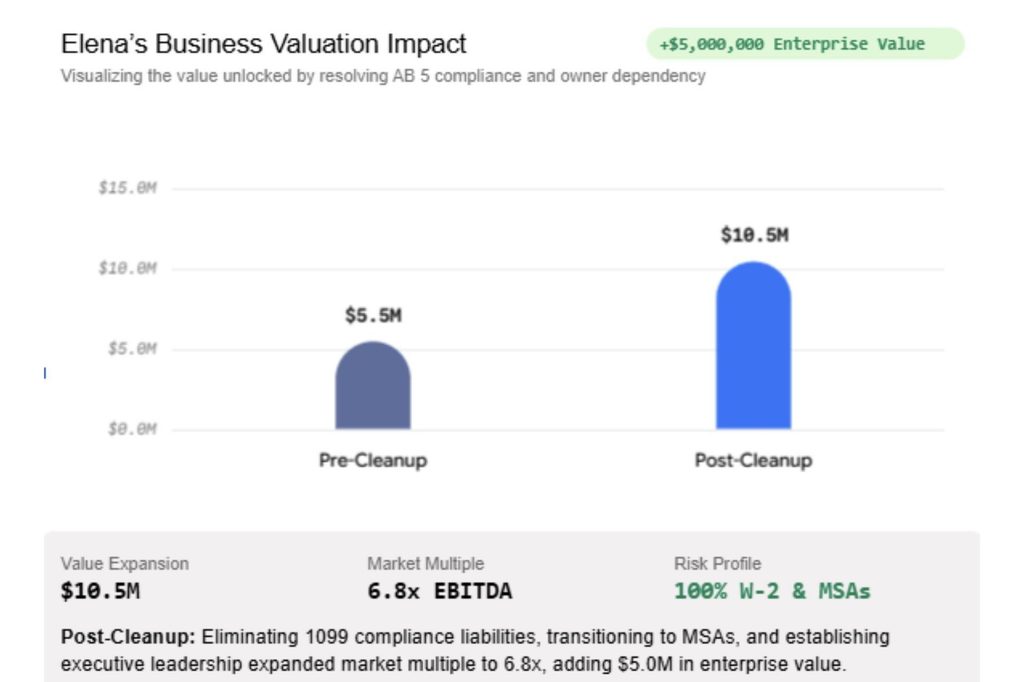
Elena sold a $12 million Southern California janitorial company at 6.8x EBITDA. The band for an unprepared cleaning business of that size is 3x to 4x, so the preparation was worth roughly twice the company. She did it in a 90-day sprint before the data room opened, then a confidential process. This janitorial M&A case study follows what she changed, what it cost her, and which buyers walked away.
The baseline she started from is the one most owners in her position face. BizBuySell’s FY2024 cleaning-sector table records 162 reported sales at an average cash-flow multiple of 2.18x, on a median revenue of $401,086 (BizBuySell, FY2024 data). The market was not slow: the Q3 2025 Insight Report counted 2,599 closed transactions, up 8% year over year, with a median of 149 days on market, the fastest since 2017 (BizBuySell, Q3 2025). Owners who want to sell a commercial cleaning business in California were not waiting for buyers. They were waiting for a price.
Key Takeaways
- Elena converted a 20% AB 5 exposure and total owner dependency into a 6.8x EBITDA exit, nearly double the 3x to 4x band for unprepared cleaning businesses, in a 90-day sprint plus a confidential process.
- The work ran in three phases: a compliance scrub, a management layer, and contract formalization.
- Converting 1099 crews to W-2 cost margin for two quarters and removed a discount larger than the payroll it added.
- Buyers who wanted a cheap asset walked. The ones who stayed paid for the crew.
How this case was built. Elena is a composite, not a client. The narrative is assembled from the recurring pattern this advisory practice sees in commercial cleaning and facility-services engagements: owners in the $2 million to $25 million revenue range who carry dispatch duties personally, whose contract base is partly handshake, and whose workforce carries some 1099 mix that diligence will surface. The situations repeat often enough that the sequence below, compliance, then management, then contracts, holds across most of them. Figures are illustrative and rounded so no single client is identifiable; the legal and market citations are real and dated so you can check each one.
Two anonymized patterns recur across those engagements. First, the classification exposure almost always concentrates in one cluster of accounts rather than the whole roster, so the first task is a census, not a wholesale reclassification. Second, the buyers who walk when cultural terms appear are almost always the ones whose model depends on replacing the workforce, and they walk early, before any serious diligence spend, which means the loss is a small one. This is not legal advice. Consult a qualified attorney for your specific situation.
The Southern California Dilemma
Elena carried the dispatch phone at 2:00 AM. When a night crew called out at a Newport Beach office tower, she answered, and when a client’s regional manager wanted an answer on a restroom schedule, she answered that too. After 31 years, she had $12 million in revenue, 240 cleaners, and a company that could not survive a week without her.
The regulatory squeeze made the phone heavier, and it runs on a published calendar. Two steps matter for a sale, and both were confirmed before the process began (rates read October 24, 2026):
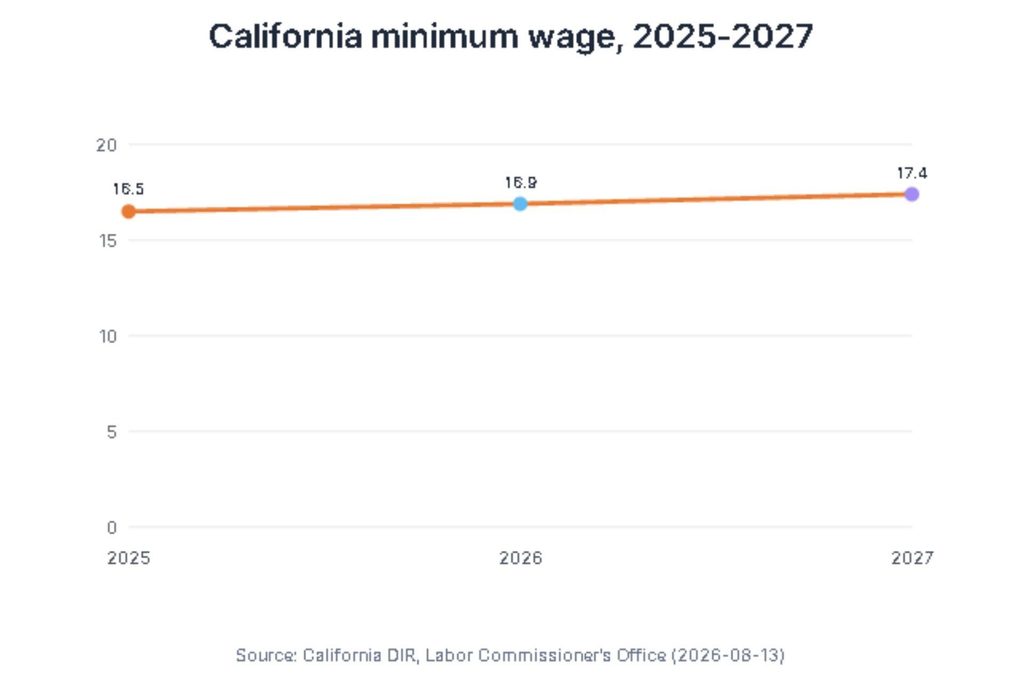
- Effective January 1, 2026: the state minimum wage moved from $16.50 to $16.90 per hour, and the exempt salary threshold moved to $70,304 (the Labor Commissioner’s announcement, December 5, 2025).
- Effective January 1, 2027: the Department of Finance certified $17.40 per hour and a $72,384 exempt threshold, confirmed on July 31, 2026 (the certified 2027 increase, August 13, 2026).
Those are the state figures. The DIR’s statewide minimum wage page adds that some cities and counties set higher rates, and employers must comply with the higher local rate (DIR minimum wage page). For a commercial janitorial exit in Orange County, the pressure came from the state schedule rather than a local ordinance patchwork; no general local rate above the state figure surfaced for Irvine, Anaheim, Santa Ana or Costa Mesa at the time of writing.
Elena’s real problem was not the wage floor. It was that 20% of her workforce worked on 1099s, and every buyer’s diligence team would find it. The DLSE’s independent-contractor FAQ states the ABC test “starts with an assumption that all workers are employees,” and the hiring entity must satisfy all three prongs: freedom from control, work outside the hiring entity’s usual course of business, and an independently established trade (the DLSE’s independent-contractor FAQ, read October 24, 2026). Cleaners performing the core service of a cleaning company fail the second prong on the agency’s own examples.
🔗 The California Founder’s Guide to Exiting a $2M-$25M Commercial Cleaning & Janitorial Business
The Pre-Market Vulnerability Assessment (The 90-Day Sprint)
The sprint began with a number Elena had never put on paper: what the classification question would cost a buyer. Under the ABC test, the DLSE’s independent-contractor FAQ explains that every worker starts as an employee unless the hiring entity proves all three prongs: freedom from control, work outside the usual course of the business, and an independently established trade of the same nature (the DLSE’s independent-contractor FAQ). The same FAQ states that LWDA entities may assess civil penalties between $5,000 and $25,000 per violation under Labor Code § 226.8, and that EDD may assess 15 percent of the deficiency under Unemployment Code § 1127(a). EDD applies the same test under CUIC § 621(b), presuming employment “unless the hiring entity can prove the worker meets all three conditions” (EDD’s DE 231 information sheet, Rev. 14). A buyer reads that stack as an escrow holdback waiting to happen.
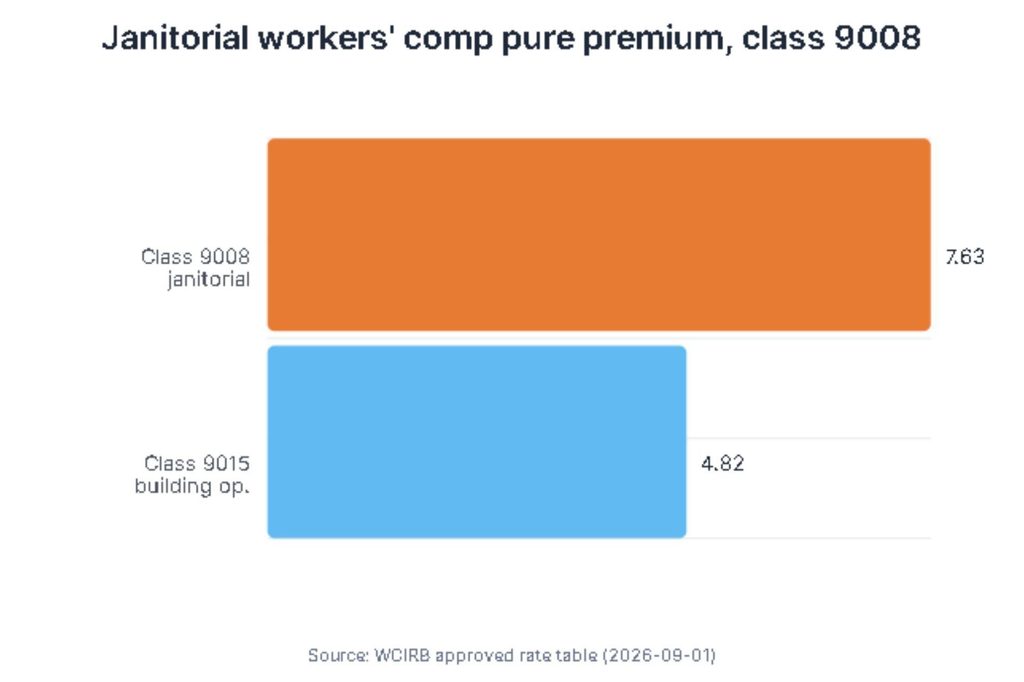
The margin hit from the 1099-to-W-2 conversion before sale is real, and Elena felt it. Employer FICA runs 7.65% of wages, FUTA applies up to $42 per employee on the first $7,000, and California UI and ETT add roughly 3.4% and 0.1% on the same wage base. Workers’ comp adds its own line: the approved class 9008 rate for janitorial services by contractors was $7.63 per $100 of payroll effective September 1, 2026, against $4.82 for class 9015 building operation (the approved class 9008 rate, rates effective September 1, 2026). The cost is temporary. The discount a buyer applies to an unresolved classification question is not.
Three phases ran in sequence:
- Compliance scrub. Reclassify the 1099 crews, rebuild payroll records, and clear wage judgments before the data room opens.
- Management layering. Move dispatch and client escalation to a salaried Operations Director, paid above the exempt threshold for the year the role starts.
- Contract formalization. Convert handshake accounts to written master service agreements with term and escalation language.
Pro Tip: Convert 1099s to W-2 before the data room opens. A buyer prices an unresolved classification question as an escrow holdback, not a conversation.
The 90-Day Sequencing Checklist
Most owners run these three phases at once and lose the benefit of the order. Sequence them, and use the checkpoints here as gates rather than suggestions.
Days 1–15: Census before action
- List every worker by account, pay method, start date and supervisor — the exposure is usually concentrated, not uniform.
- Pull four years of payroll, 1099 filings and any wage claims or settlements.
- Ask counsel to size the penalty range under Labor Code § 226.8 and Unemployment Code § 1127(a) before deciding how to convert.
- Gate: you can state the exposure in dollars. If you cannot, do not open a data room.
Days 16–60: Reclassify and rebuild
- Convert the identified cluster to W-2 first; it is the smallest accurate change, not the biggest possible one.
- Rebuild payroll records so each worker’s status is documented per pay period.
- Hire or promote the Operations Director above the exempt threshold, and hand over dispatch and client escalation in writing.
- Gate: a buyer’s diligence team can reconcile headcount to payroll to insurance without asking you a question.
Days 61–90: Make the revenue buyer-ready
- Convert the largest handshake accounts to written MSAs with a term and a CPI escalator; start with the accounts that represent the highest share of revenue.
- Assemble the workers’ comp experience modification and claims history into the diligence file.
- Build the buyer screen: 100-day plan request, reference calls, and the cultural terms you will not trade away.
- Gate: the data room answers questions about labor, contracts and risk before they are asked.
What not to do: do not convert the entire roster in week one to look clean, and do not sign new contracts with escalation language you cannot defend to an existing client. Both create a diligence question where there was none.
This is not legal advice. Classification analysis depends on facts specific to each engagement, and the ABC test carries statutory exceptions, including the business-to-business exception in Labor Code § 2776, which requires, among other things, a written contract stating the services, the rate of pay and the payment due date (the statutory text of § 2776, appendix 2021). Consult a qualified attorney before changing a worker’s status.
For the legal mechanics rather than the deal mechanics, the two primary sources are worth reading in full: the DLSE independent-contractor FAQ and the EDD DE 231 information sheet, which state the ABC test and the penalty exposure in the agencies’ own words.
Framing the Asset: Selling Contractual Cash Flow, Not Mops
The repositioning changed the price before a single buyer saw a financial statement. Elena stopped describing a cleaning company with a big staff and started describing a facilities platform with recurring revenue. Axia Growth’s facility-services analysis explains why buyers pay for that framing: dense routes cut windshield time, fuel, overtime and duplicate back-office cost, and multi-year contracts reduce underwriting risk and support debt capacity (Axia Growth’s facility-services analysis, updated October 3, 2026).
The California cleaning business valuation multiple depends on what the buyer is underwriting. Three things moved Elena’s number:
| What buyers underwrite | Weak version | Strong version |
|---|---|---|
| Revenue type | Handshake accounts, month-to-month | Written MSAs with term and CPI escalator |
| Labor | 1099 mix, unresolved | All W-2, clean payroll, no judgments |
| Route density | Scattered stops, overtime | Dense routes, controlled labor cost |
The legal reason the labor column matters so much in California is specific to this industry. Labor Code § 1434, enacted in 2017, expressly imposes successor liability on a janitorial services provider that meets any of four criteria, including using substantially the same workforce to offer substantially the same services as the predecessor (the janitorial-specific successor rule in Labor Code § 1434, November 15, 2019). An asset purchase does not cleanly protect a buyer who keeps the same crews and supervisors. A seller who already has W-2 crews, clean payroll and no wage judgments removes that risk from the table, and a removed risk is worth a premium rather than a discount.
The master service agreement CPI escalator did the rest of the work. A 36-month contract with an annual escalator gives the buyer a revenue line that rises with the wage floor instead of eroding against it, which is the difference between a business that defends its margin and one that absorbs every January increase. Private equity roll-up commercial cleaning buyers understand this arithmetic better than anyone, because they are buying the same contracts across a platform.
- 🔗 Why Commercial Contracts Dictate Cleaning Valuations: Escaping the 2x Residential Multiple
The Matchmaking Process: Filtering for Culture
Some buyers walked, and that was the point. Elena attached conditions to the sale: buyer-funded severance triggers if headcount or pay was cut in year one, retention bonuses for her supervisors, and a written commitment to the crews. Two financial buyers ended the conversation when they read the terms. The ones who stayed had already planned to keep the workforce, because in a labor-short industry the crew is the asset.
Protecting employees when selling a business is not sentiment. Retention and stay bonuses in lower-middle-market deals commonly cover 12 to 24 months and are sized at roughly 15% to 30% of base salary (ClearlyAcquired’s retention-bonus benchmarks, read October 24, 2026). That sizing is advisory practice rather than a measured benchmark, and it is the range Elena used to price her Operations Director’s stay package.
The screening ran both directions. Elena asked each buyer for a 100-day plan: what would be preserved, what would change, and who would hold decision rights over scheduling and client escalation. She asked for reference calls with sellers from the buyer’s prior deals. A buyer who could not describe the first 100 days in writing was a buyer who would discover the crew on day 101.
The objection she heard most was switching risk: that attaching cultural terms would scare off the highest bidder. The evidence from her process ran the other way. The buyers who accepted the terms had already underwritten the labor force, which meant they were not planning to re-cut it after closing. The buyers who refused were pricing a workforce they intended to replace, and a replaced workforce is a service interruption the client notices.
- 🔗 Protecting Your Cleaning Crews: Ensuring Continuity for Your Labor Force Post-Acquisition
Achieving the Win-Win
The 6.8x multiple is credible because it is explained, not because it is average. Three Sixty Seven Advisors’ May 2026 janitorial multiple grid puts U.S. commercial janitorial businesses at 4.5x to 6.0x EBITDA in the $1 million to $3 million EBITDA band, and reserves 8x to 12x for premium platforms (the May 2026 janitorial multiple grid, May 2026). A $12 million-revenue janitorial at roughly $1.5 million to $1.8 million EBITDA sits in that band.
Elena’s 6.8x is above the 4.5x to 6.0x core band and below the 8x-plus premium tier. Two things justify the gap: 36-month MSAs with CPI escalators that convert the revenue line into contractual cash flow, and an all-W-2 payroll with no unresolved classification exposure or wage judgments. Buyers price each of those as a removed risk, and removed risk is what moves a multiple from the middle of a band to the top of it. The same logic works in reverse: the 3x to 4x band at the start reflects a business where both risks were still live.
| Metric | Before | After |
|---|---|---|
| EBITDA multiple | 3x to 4x band (unprepared comps) | 6.8x |
| 1099 reliance | 20% of workforce | 0% (all W-2) |
| Owner dependency | Elena on the dispatch board | Operations Director; 1 day/week advisory |
| Contract term | Handshake accounts | 36-month MSAs with CPI escalators |
The workers’ comp file made the payroll underwritable. CHSWC’s 2024 annual report records an average charged rate of $1.63 per $100 of payroll in 2024, up from $1.60 in 2023, and a projected average cost of $76,012 for a 2023 lost-time claim excluding COVID (CHSWC’s 2024 annual report, 2024). A buyer can underwrite a W-2 payroll with a controlled experience modification. A buyer cannot underwrite a 1099 roster with no claims history at all.
The transition was phased over 12 months, and the 60-day notice rule shaped the schedule. Cal-WARN requires 60 days’ written notice to employees, and EDD before a mass layoff, relocation or termination at a covered establishment, and an employer that fails to give notice is liable for back pay and benefits for each affected employee for up to the lesser of 60 days or half the days employed (the 60-day notice rule, read October 24, 2026). Phasing the handover kept the workforce intact and kept the notice question off the table.
Warning: Converting 1099s to W-2 costs margin in the short term. Budget for it before you go to market. The valuation discount it removes is larger than the payroll cost it adds.
- 🔗 Surviving “The Day After”: Walking Away from the Operations Board After 30 Years
The Power of Intentional Stewardship
Elena’s exit worked because she treated the sale as an operating project, not a listing. She fixed the classification question before a buyer could price it, moved herself off the dispatch board, and put the crew’s continuity into the deal terms in writing. The multiple followed the preparation.
The transferable lesson is the order of operations. Compliance first, because the ABC test and § 1434 both punish a buyer who inherits the same crews and the same unresolved payroll. Management second, because a business that needs the founder at 2:00 AM is a job, not an asset. Contracts third, because a 36-month agreement with an escalator is the revenue line a lender will finance.
The cost is honest, and it is front-loaded. Two quarters of compressed margin, a salaried supervisor above the exempt threshold, and a handful of buyers who walk away from cultural terms. What the owner gets in return is a crew that keeps its jobs, a buyer who has already underwritten the labor force, and a price that reflects the risk removed rather than the risk hidden.
The multiples in this case are illustrative and should be read that way, not as benchmark data. Use the published grids and reported-sale tables cited above as your reference points, and let your own contracts, payroll records and claims history determine where inside a band your business lands.
If you are carrying the dispatch phone tonight, the question worth asking is not whether the market is hot. It is which of the three risks above a buyer would find first in your files, and how long you have before that happens. That answer depends on what you do in the next 90 days.
If it would help to talk it through, that conversation is confidential and starts with your labor force, your commercial contracts and your timeline. Nothing above commits you to a sale.
- 🔗 Partnering with Vinil Ramchandran: Stewardship for the Lower Middle Market Cleaning Exit
This is not legal advice. Consult a qualified attorney for your specific situation.
