

Cleaning Business Valuation Multiples: Commercial vs Residential
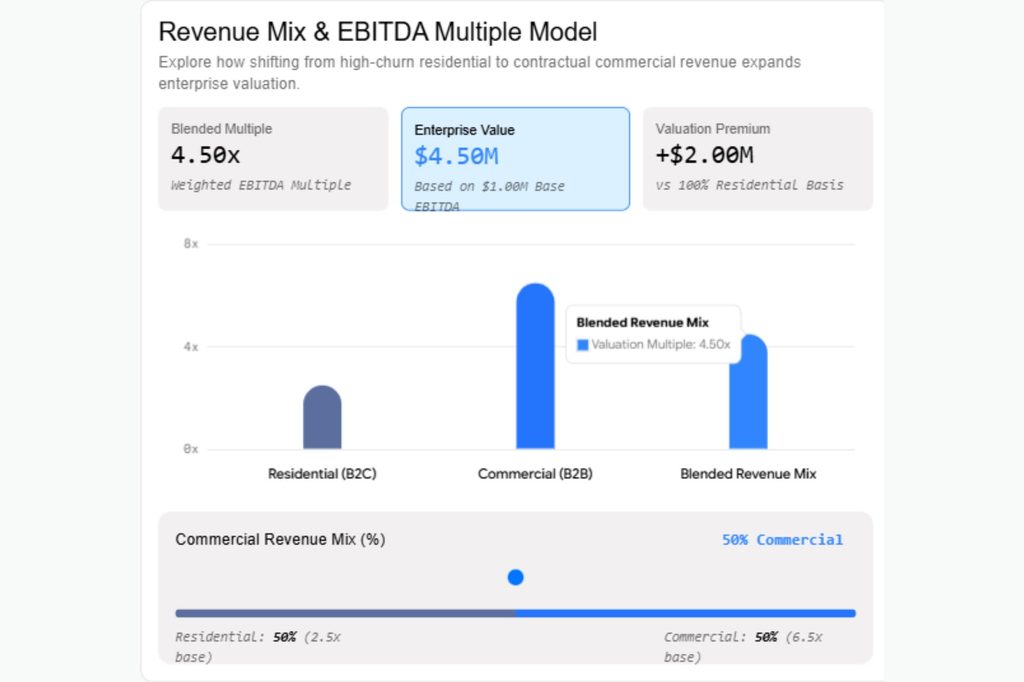
cleaning company with $6 million in revenue and $900,000 in owner earnings can sell for roughly 2.5x, or roughly 6.0x. The gap is not sales growth. It is the paper behind the revenue. One book is residential and month-to-month; the other is commercial, documented, and diversified. Buyers pay for the second book and discount the first, and the published cleaning business valuation multiples show why: half of all cleaning and janitorial businesses sold between 2021 and 2025 changed hands between 1.57x and 2.66x annual seller’s discretionary earnings, with a median of 2.07x (BizBuySell’s cleaning and janitorial benchmark, dataset 2021–2025). That is the residential multiple in the title, and it is measured, not asserted.
The 2.5x and 6.0x figures are an illustrative scenario, not a case study. What is real is the gradient. The private planning screens in Level CFO’s cleaning market monitor, published April 2026, put $3M to $10M revenue companies at 4x to 7x EBITDA, while sub-$ 3 M companies at 2x to 4x SDE. The premium exists, but it is not visible in the sector median. It appears only when a book is split by contract quality and size.
| Company A | Company B | |
|---|---|---|
| Revenue | $6.0M | $6.0M |
| — | — | — |
| Owner earnings | $900K | $900K |
| Revenue mix | Residential, month-to-month | Commercial MSAs, multi-year |
| Contract backing | Verbal or 30-day terms | Written, assignable, renewal-tested |
| Churn | High, seasonal | Low, contracted |
| Typical buyer | Individual operator | Regional platform or PE-backed consolidator |
| Multiple band | ~2.0x–2.7x SDE (BizBuySell, 2021–2025) | ~4x–7x EBITDA (Level CFO, April 2026) |
Key Takeaways
- Cleaning business valuation multiples cluster near 2.07x earnings because the median sold business is small and owner-run, not because cleaning is a weak industry.
- Commercial contracts are priced on notice period, renewal mechanics, and concentration, not on contracted revenue.
- A 12-to-24-month program of revenue-mix shifting, contract fortification, and diligence documentation is what moves a book from the 2x band toward the upper ranges.
The Gross Revenue Illusion
Gross revenue is the number owners quote, and the number buyers largely ignore. The cleaning and janitorial dataset behind BizBuySell’s benchmark shows a median sale price of $260,000 against median revenue of $433,327 and median owner earnings of $136,326, an average revenue multiple of just 0.70x (BizBuySell’s five-year cleaning dataset, 2021–2025). Revenue is the denominator of a scale story. Earnings are what gets multiplied.
The multiple itself is not one number. Buyers switch earnings definitions as businesses grow: SDE is the norm for owner-run businesses under about $2 million in revenue or under $500,000 of SDE, while EBITDA, calculated after a market-rate manager salary, applies to larger, management-run businesses (the SDE-to-EBITDA switch most buyers make around $2 million in revenue). A $6 million book is therefore priced on EBITDA, and the quality of that EBITDA determines the turn.
| Company A | Company B | |
|---|---|---|
| Revenue | $6.0M | $6.0M |
| — | — | — |
| EBITDA | $900K | $900K |
| Revenue mix | 80% residential, month-to-month | 85% commercial, written MSAs |
| Contract backing | No written agreements | Top 10 accounts documented, renewal calendar current |
| Largest account | n/a | 11% of revenue |
| Buyer type | Individual operator | Regional facility-services consolidator or PE-backed platform |
| Illustrative multiple band | ~2.0x–2.7x | ~4.5x–6.0x |
Table 1: Two identical earnings bases, two different books. Bands reflect the BizBuySell cleaning interquartile range of 1.57x–2.66x and the Market Pulse Q2 2026 size-band medians of 2.8x to 5.8x; they are ranges, not quotes.
The objection every founder raises at this point is fair: the revenue is strong, so why is the offer low? Because the buyer is not buying revenue. The buyer is buying the probability that the revenue survives the closing, and residential revenue carries a different survival profile than a documented commercial book.
The Residential Trap: Why B2C Revenue is Heavily Discounted
That survival profile is what separates the two books, and it starts with what the buyer can hold onto after closing. When owners ask about selling residential cleaning vs. commercial, the honest answer is that residential clients are recurring by habit, not by contract. There is no term, no notice period, and no assignment clause, so the buyer underwrites each household as a discretionary purchase that can stop in any given month. Furthermore, the loyalty of a client is often with the cleaner that cleans their home every week and not with the company behind it. So, if the cleaner decides to buy some basic cleaning equipment and go independent, that customer could be at risk.
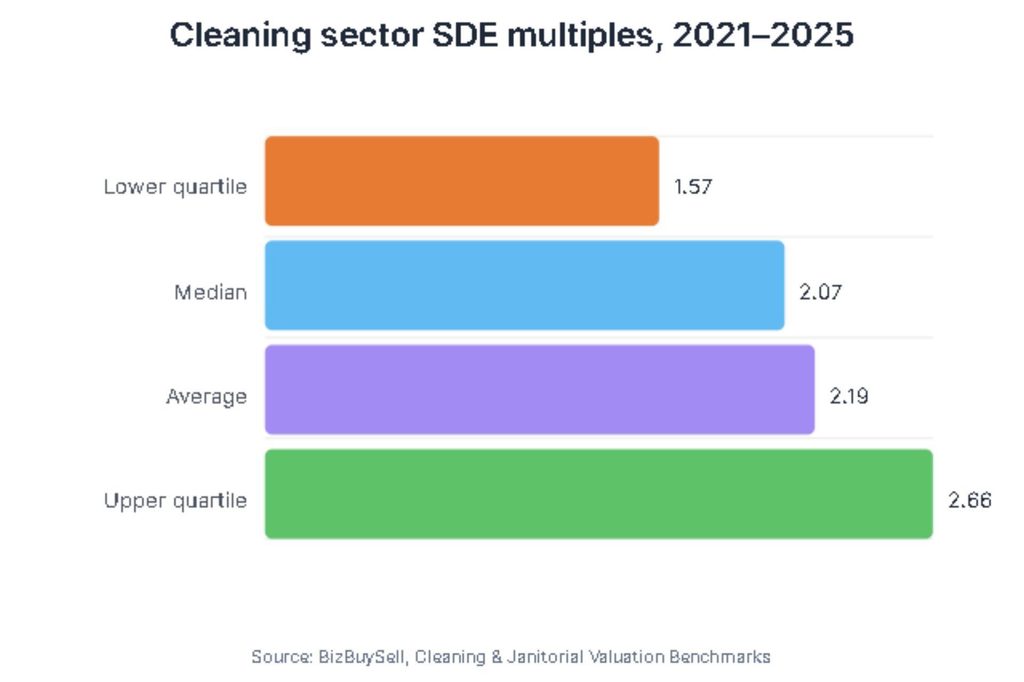
The market prices that uncertainty directly. The median cleaning and janitorial business took 165 days to sell in the five-year dataset, and the median sale price was $260,000 (the five-year cleaning and janitorial dataset on BizBuySell, 2021–2025). Slow sales and small absolute prices are what a book of individually replaceable customers looks like on a listing platform.
Size compounds the discount. In the third quarter of 2026, deals under $1 million priced at 2.30x cash flow while deals above $1 million priced at 3.73x (BizBuySell’s Q3 2026 Insight Report, Q3 2026). A residential-heavy book rarely clears the $1 million deal threshold, which keeps it in the lower band regardless of how well it is run.
There is also a cost the P&L hides. Residential revenue requires continuous customer acquisition to stand still, and that acquisition spend is the first thing a buyer re-examines. A commercial book with written agreements does not eliminate churn, but it converts churn into a dated, forecastable event rather than a monthly surprise.
- 🔗 The California Founder’s Guide to Exiting a $2M-$25M Commercial Cleaning & Janitorial Business
The Commercial Premium: De-Risking the Cash Flow
The commercial premium in a commercial cleaning contract’s EBITDA multiple is real, but it is narrower than the marketing suggests, and it is earned clause by clause. ABM Industries, an $8.7 billion facility-services consolidator, discloses that its service agreements are “generally one-year renewable agreements,” most are “cancelable by either party without a substantive penalty,” and cancellation runs on 30 to 90 days’ notice (ABM’s own 10-K describes agreements cancelable by either party on 30 to 90 days’ notice, FY2025). Commercial contracts are not multi-year moats. They are renewable relationships with a defined exit window.
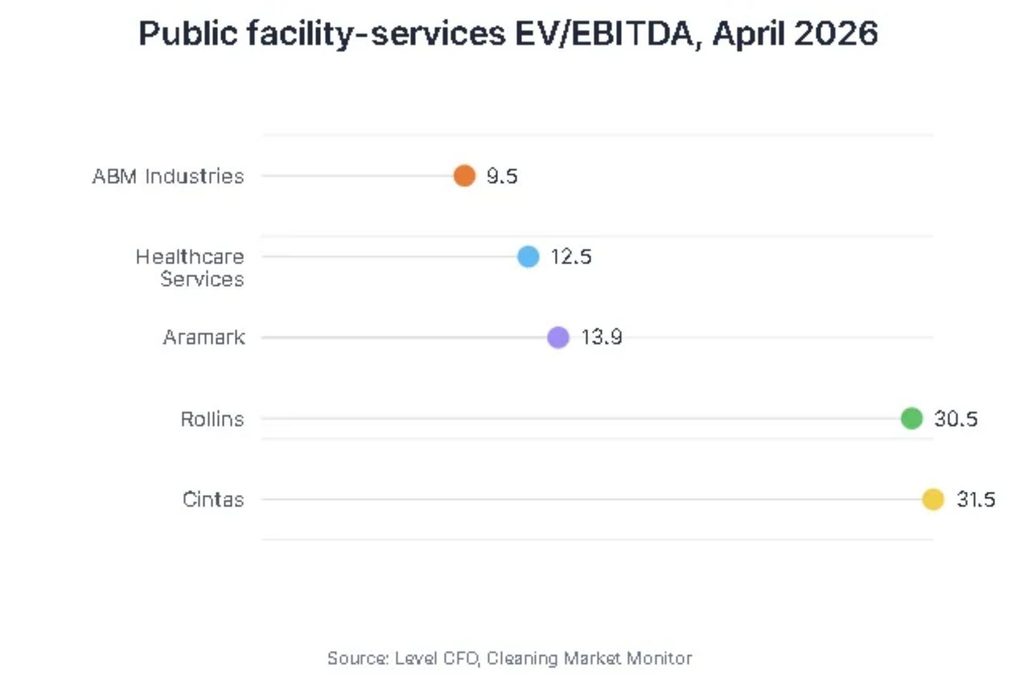
Healthcare Services Group describes the same architecture in its healthcare housekeeping and dietary contracts: a one-year renewable service term, cancellable by either party on 30 to 90 days’ notice after an initial period of 60 to 120 days (Healthcare Services Group’s latest quarterly filing, Form 10-Q for the period ended 30 June 2026). The same filing states that no single customer or customer group exceeded 10% of consolidated revenues. That combination, short notice plus low concentration, is what a buyer can underwrite.
| MSA term | What the contract typically says | The buyer’s underwriting question |
|---|---|---|
| Term and renewal | One-year renewable; some auto-renew in successive 12-month periods | Does renewal happen by default or by re-bid? |
| Cancellation notice | 30 to 90 days for either party; 30 days for convenience in some municipal agreements | How much revenue can leave before I can react? |
| Cure period | 30 days to cure deficient performance in a model municipal agreement | Is termination for cause or for convenience? |
| Price escalator | Wage-floor pass-through where prevailing-rate logic applies | Does margin survive a wage increase? |
| Assignment and change of control | Consent required, or the contract travels with the entity | Does the contract survive my sale at all? |
Table 2: The anatomy of a bankable MSA, drawn from the ABM 10-K (FY2025), the HCSG 10-Q (filed 24 July 2026), and a model municipal janitorial agreement executed in 2017 (City of Brentwood janitorial service agreement).
The strongest counterargument is concentration, and it deserves a straight answer. Buyers assume meaningful post-close revenue loss once any single customer passes roughly 15% to 20% of revenue, and they push hard at 30% or more (ring-fencing the whale instead of discounting the whole company). A big anchor client is a strength only while it stays under those lines. Above them, it becomes a pricing mechanism.
Advisor Insight: In one worked structure, a buyer offered 5.5x on diversified EBITDA but only 2.0x on the concentrated account, and a renewal-contingent earn-out was designed to close the gap toward 4.5x on that tranche (the firm’s concentration example). The lesson for a cleaning founder is structural: buyers split the book rather than discounting all of it, so the answer to “what if the buyer blends my accounts” is to arrive with the split already drawn.
The “Crown Jewels”: Medical, Industrial, and Prevailing Wage
That same logic- that buyers underwrite what is documented and verifiable- is why specialty work commands attention in a janitorial contracts valuation California analysis: the compliance burden is visible, documentable, and hard to fake. A medical account is not priced on square footage. Infection-control practitioners use a risk assessment to identify high-touch surfaces and set the cleaning and disinfection schedule with housekeeping staff, and patient-care workers receive periodic training in environmental surface infection control (CDC environmental-services guidance, guideline 2003, page updated 8 January 2024). That means the scope is written per facility and audited, which is a different product from a generic square-foot contract.
California adds a compliance layer a buyer can verify. Janitorial employers must register with the Labor Commissioner under the Property Service Workers Protection Act, paying a $500 non-refundable application fee, renewing annually at $500, and providing sexual-harassment prevention training every two years (California’s janitorial employer registry). The definition of employer reaches anyone who engages by contract, subcontract, or franchise arrangement for janitorial services, and a covered worker includes any independent contractor or franchisee predominantly working as a janitor.
Where occupational exposure exists, Cal/OSHA’s bloodborne pathogens standard requires a written Exposure Control Plan, accessible to employees, reviewed and updated at least annually (the bloodborne pathogens standard, Title 8 Section 5193). Hepatitis B vaccination must be made available within 10 working days of initial assignment, and training records are kept for three years (Cal/OSHA’s Title 8 Section 5193). The standard is conditional on exposure determination, so it is not a blanket requirement for every commercial account.
Public work carries its own wage floor. California’s prevailing wage laws require the general prevailing rate on public works contracts, including contracts let for maintenance work, and Public Utilities Code sections 465 and 466 extend prevailing-rate logic to custodial and janitorial labor in that context (California’s prevailing wage laws, revised 1 February 2025). The published compilation covers construction and specified housing work, so a cleaning firm should confirm coverage for its specific contract rather than assume it.
- 🔗 The Margin Squeeze: Scaling vs. Selling Your Janitorial Business in a High-Wage Market
Resources: California DIR janitorial registration page; Cal/OSHA Title 8 Section 5193; DIR prevailing wage compilation (revised 1 February 2025).
Operationalizing Your Revenue Mix Pre-Sale
Document that compliance is one workstream of a greater effort, and the 12-to-24-month program starts with the file, not the sales pitch. The first artifact buyers ask for is a top-10 customer table with percent of revenue, contract status, and renewal dates, followed by a cash-to-accrual bridge with a working-capital peg, revenue by customer, gross margin trends, churn, and an AB5 classification memo (the customer-concentration table buyers ask for first). A small office can build this in a quarter with a bookkeeper and a spreadsheet.
- Weeks 1–4: Build the concentration file. Top-10 table, renewal calendar, notice periods, and assignment clauses for every account. Flag anything above 15% of revenue.
- Months 2–6: Shift the mix deliberately. Add commercial accounts at a measured pace while keeping residential cash flow intact. The goal is not to abandon residential; it is to make commercial the majority of EBITDA.
- Months 3–9: Fortify the paper. Seek auto-renewal terms, longer notice periods, cure provisions, and price escalators in the top accounts. Where a client will not sign a longer term, document the renewal history instead.
- Months 6–12: Commission a sell-side quality-of-earnings report. Tax accounting and transaction accounting pull in opposite directions, and multiples magnify the impact of an undisciplined add-back (why a sell-side quality-of-earnings report pays for itself).
- Weeks 8–12: Audit worker classification. The ABC test, which AB 5 codified in 2020, requires that a worker perform work outside the usual course of the hiring entity’s business, and cleaning is the usual course for a janitorial company (the ABC test, which AB 5 codified in 2020). Janitorial is expressly excluded from the business-to-business exception, so 1099 cleaner arrangements are exposed on two fronts at once.
The cost objection is legitimate but smaller than it looks. A founder running a 40-crew company with two office staff does not need a full finance department; the file is assembled once and refreshed quarterly. The revenue-risk objection is the one to take seriously. Shifting mix means turning down some residential growth, and the plan should protect the existing book before adding commercial volume.
A composite example shows how the sequence plays out in practice. Picture a Southern California janitorial company at $4.5 million in revenue, about 70% residential, run by an owner who wanted to retire within two years. The owner spent the first quarter building the concentration file and discovered that three commercial accounts made up 38% of revenue, one of them a medical office building on a handshake renewal. Over the next six months, the company added two mid-sized commercial accounts, capped any single client at 12% of revenue by refusing one oversized bid, and negotiated auto-renewal language into the medical account. By month twelve, commercial work had moved from 30% to just over half of EBITDA, and a sell-side quality-of-earnings report tied the numbers to the paper. The company did not grow dramatically; it changed what the same revenue was worth. This is a composite illustration assembled from common patterns, not a specific client engagement, and individual results will vary with contract terms, concentration, and market conditions.
Advisor Insight: The lesson from these engagements is sequencing, not speed. Founders who start with the concentration file and the quality-of-earnings work typically arrive at market with a defensible story; founders who start with a listing often end up explaining gaps the buyer already priced in.
The mechanism is proven in other industries. In one 90-day escrow, a Southern California contractor at roughly $15 million in revenue signed an LOI at 5.5x, then faced a $750,000 retrade in month two. The seller answered with a weather-adjusted five-year revenue series and a pre-built quality-of-earnings file, and the buyer withdrew the demand within 48 hours, closing at 5.5x in full cash at close (the firm’s 90-day escrow case study, reviewed 19 March 2026). The same discipline applies to a cleaning book: buyers split the business rather than discounting all of it (splitting the business rather than discounting the whole company).
- 🔗 The AB 5 Diligence Minefield: Cleaning Up Worker Classification Before You Sell
Packaging the Contracts Through
Stewardship
The takeaway is earned, not asserted: cleaning business valuation multiples follow the paper, and the paper can be built. A California cleaning business priced on SDE typically lands between 1.5x and 4x, and one priced on EBITDA between 2x and 6x, with industry, niche, growth, scale, management team, and lease stability as the stated drivers (the firm’s published California ranges). Public cleaning companies trade near 5x EBITDA on a trailing basis (public cleaning companies trade near 5x EBITDA, data as of 4 July 2026), which is a ceiling for a private book, not a comparable.
The buyer who tries to blend your accounts into one blended multiple is pricing the wrong unit. The answer is to arrive with the split already drawn: the diversified core priced on its own merits, the concentrated account ring-fenced with a renewal-contingent structure, and the file that proves both.
If you are twelve to twenty-four months from a sale, the highest-return work is rarely a listing. It is a quiet review of your contracts, your revenue mix, and your concentration profile while you still have time to change the answer.
If that timing describes you, a confidential Revenue Quality & Contract Valuation Audit can map your book against the ranges buyers are paying today. There is no obligation, no listing, and no disclosure to your staff or clients, and you are welcome to take the findings to your own CPA or attorney and act on them independently.
- 🔗 Partnering with Vinil Ramchandran: Stewardship for the Lower Middle Market Cleaning Exit
