

Protect Employees When Selling Your Business
Your crews are the reason a buyer is at the table. In California, the people who strip and wax a Class-A lobby at 2 a.m. are also the hardest part of a janitorial business to replace: the state employed 245,790 janitors and cleaners at a mean hourly wage of $20.13, against a national mean of $17.43 (BLS wage data for janitors and cleaners, May 2023). Nationally, the Occupational Outlook Handbook projects about 321,800 janitor openings a year through 2035 against employment growth of just 2%, which means most hiring is replacement, not expansion.
That scarcity is your leverage. You can protect employees when selling your business by trading labor protections into the deal itself: severance triggers in the letter of intent, a time-boxed integration role, and a scripted Day 1 announcement. None of it requires the buyer to pay more at closing, and all of it is negotiable before you sign.
The failure mode is the founder who asks for a verbal promise to “keep everyone” and gets nothing enforceable. Selling a cleaning business in California means putting the promise in writing, with a trigger, a fund, and an end date.
Written by Vinil Ramchandran, founder of Dream Business Brokers and a certified business intermediary (CBB, CM&AP) with more than 25 years across corporate management and small business ownership. The frameworks below come from our own exits in service and facility businesses, not from a template.
Key Takeaways
- Labor protections are a non-financial consideration: they cost the buyer little at closing and can be traded against price, escrow, or transition terms.
- A severance covenant needs three parts to be real: a defined trigger, a funded source, and a neutral administrator with audit rights.
- The integration role should carry deliverables, a reporting line, and an end date, because open-ended consulting language invites role expansion.
- The Day 1 town hall is a logistics problem before it is a communications problem: identical sessions on every shift, paid attendance, supervisors briefed first.
Why Institutional Buyers Need Your Labor Force
A buyer’s biggest post-close risk in commercial cleaning is not the contract book. It is the night crew walking out with the account knowledge in their heads. The cleaning industry reported annual turnover “anywhere between 100 and 400 percent” before 2020, an estimated 3.6 times the national average, according to one widely repeated industry estimate. That figure carries no named study or methodology, so treat it as a trade-press claim rather than a measured rate. It still describes the problem every operator recognizes.
Replacement is expensive. The same article relays replacement-cost estimates of one-half to two times annual salary from a 2019 Gallup poll and three to four times annual salary from a 2023 Forbes report. The two figures conflict, and the Forbes number is the more recent and is presented as the correction. Both are secondhand citations, so use them as a range borrowed from general workforce research, not as a janitorial measurement.
For a founder, that math flips into negotiating power. When you run a 40-person night crew across six Class-A accounts, every supervisor who leaves takes route knowledge, client relationships, and training time with them. A buyer who plans to cut headcount is buying a churn problem it will pay for twice: once in the purchase price and again in replacement cost. Janitorial employee retention after acquisition is therefore a buyer’s problem before it is yours, and night crew retention in commercial cleaning is the specific asset the buyer is paying for.
The legal frame matters here too. Under the federal WARN regulations, the seller is responsible for notice of any plant closing or mass layoff occurring up to and including the closing date, and the buyer is responsible for events after closing. Employees who keep working for the buyer are generally not treated as having suffered an employment loss from the sale itself. That rule cuts both ways: a buyer that keeps the crew inherits no WARN event, and a buyer that cuts the crew after closing owns the notice obligation. Put that in the purchase agreement and the buyer’s incentive to retain becomes structural.
Private equity roll-up employee protections are not a courtesy in this market. Consolidation is active across facility services, and platform buyers run integration playbooks built before they ever see your roster. The question is not whether a buyer has a plan for your people. It is whether your deal documents shape that plan.
From the Field (illustrative scenario, not a specific client): Picture a 32-person commercial cleaning company in the Inland Empire with four long-tenured night supervisors. The LOI came in from a regional consolidator with a standard 90-day “synergy review” scheduled for month three. The founder’s first instinct was to ask for a promise that no one would be cut. His advisor reframed it as a risk-allocation term: a buyer-funded severance escrow triggered by any headcount reduction inside twelve months. The buyer agreed in a single call, because the cost only materialized if the buyer itself chose to cut. Six months later, two supervisors were let go during a route consolidation and paid out of the escrow within the stated timeline, with the seller’s neutral agent verifying the list. The founder had no leverage after closing, but he did not need any: the terms had already done the work. That is the difference between asking for kindness and buying protection.
Pro Tip: Build a retention roster before the letter of intent: name, tenure, shift, account, supervisor, and any certification. Put it in the data room. A buyer that sees a tenured, documented crew prices continuity into the offer instead of discovering it after closing.
- 🔗 The California Founder’s Guide to Exiting a 2M-25M Commercial Cleaning & Janitorial Business
Negotiating the Non-Financials: The Protective Covenants
Employee protections in the letter of intent work because they are cheap at closing and expensive later. A covenant is a written promise in the purchase agreement with a defined trigger and a remedy. Three covenants do most of the work in a janitorial deal, and each one answers a different risk.
| Covenant | What it says | Who funds it | Failure mode if omitted |
|---|---|---|---|
| Severance trigger | Buyer pays pre-negotiated severance if it cuts headcount or base pay inside a defined window after closing | Buyer, through a special escrow held by a neutral agent with monthly reporting and audit rights | Crew cuts happen quietly in month four and the founder has no recourse |
| Retention bonus | Named employees stay for a fixed period in exchange for a lump sum, installments, or milestone payments | Buyer post-close, seller at close, or purchase-price escrow | Supervisors take the first competing offer and the account follows them |
| Final-pay and successor allocation | Assigns who pays final wages, accrued vacation, and any successor liability | Seller at separation, with indemnity from buyer | A wage claim surfaces after closing and both sides point at each other |
Start with severance. A severance covenant is a contractual obligation requiring the buyer to pay pre-negotiated severance if it reduces headcount or base pay within a defined window after closing. The window in common use runs 6 to 18 months. Funding and administration should run through a buyer-funded special escrow administered by a neutral agent, with monthly reporting to the seller and audit rights. Without those three parts, the promise is a sentence in a document nobody enforces.
Retention bonuses pair with severance rather than replacing it. Retention bonus design in M&A calls for a named or objectively defined eligible group, a fixed retention period commonly 6 to 24 months with awards clustering at 13 to 18 months, and payment by lump sum, installments, or milestones. The Skadden guide also flags the protection that matters most to a seller: termination without cause, a material cut in duties or pay, or relocation should trigger full or prorated payment. The purchase agreement should require the buyer to execute the employee agreements at closing, attach the forms as exhibits, and bar adverse amendments without seller consent.
Then handle the California wage rules, because they decide who owes what at separation. Under California’s final-pay rules, a discharged employee must be paid all wages due at the time of termination under Labor Code §201, and “all wages” includes earned but unused vacation under §227.3. A willful failure to pay triggers a waiting-time penalty of up to 30 days of wages under §203. Whether the sale creates a final-pay event depends on structure: in a stock or membership-interest sale the employing entity survives, so the ownership change alone does not trigger final pay, while in an asset sale the seller generally must pay all wages due, including earned vacation, at separation. That distinction is counsel guidance built on the DIR rules, not DIR text, so confirm it with your attorney before you rely on it.
Successor liability is the clause buyers push back on hardest. The successor-liability statute added in 2021, Labor Code §200.3, makes a successor liable for wages, damages, and penalties owed to the seller’s former workforce under a final judgment, and successorship is established by meeting any one of four criteria. One criterion is using substantially the same facilities or workforce to offer substantially the same services. A buyer that keeps your crews, your buildings, and your supervisors can meet it. The liability is judgment-based, not automatic, but it is real enough to justify an indemnity and a holdback.
Penalty exposure has narrowed but not disappeared. The 2024 PAGA reform kept the default civil penalty at $100 per aggrieved employee per pay period for an initial violation and $200 for each subsequent violation, capped penalties at 15% for employers that took all reasonable steps to comply before notice and 30% for steps taken after, and capped wage-statement penalties at $25 for harmless violations. The reform also removed derivative penalties, so a plaintiff can no longer stack a §203 penalty on top of an underlying wage underpayment. That reduces the tail risk a buyer inherits, which is a useful fact when you ask for protections.
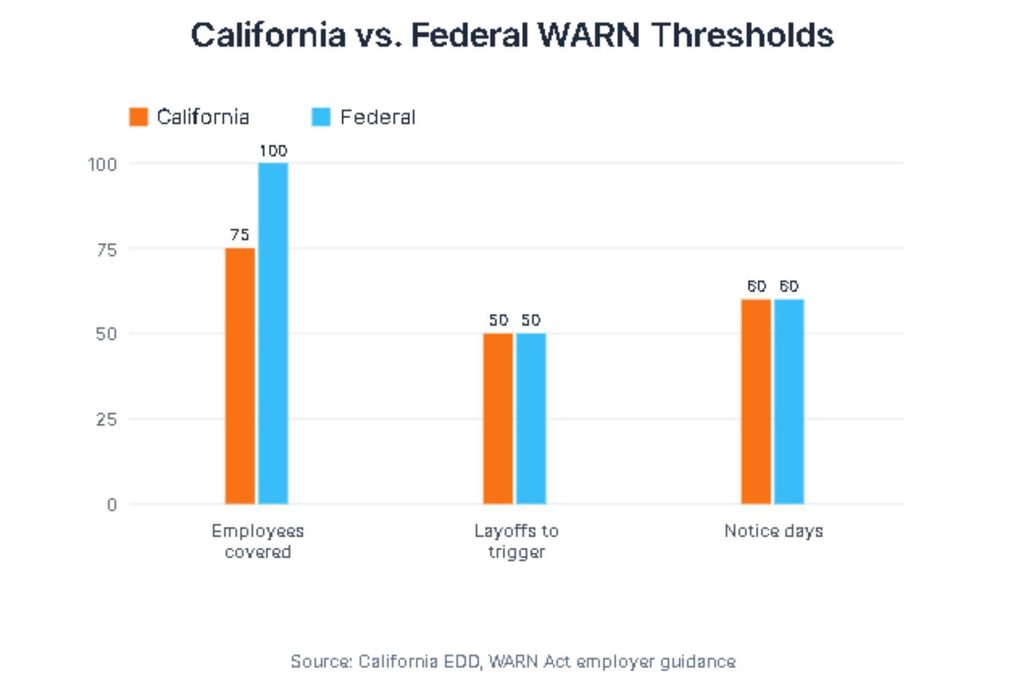
WARN thresholds belong in the same conversation. California’s WARN thresholds cover a “covered establishment” that employed 75 or more full- and part-time employees in the preceding 12 months, trigger on a layoff of 50 or more employees within 30 days, and require notice at least 60 days before the layoff. Federal WARN applies at 100 or more full-time employees. A California employer can owe state notice and back pay on a layoff that triggers no federal obligation, which is exactly the scenario a buyer’s integration plan can create.
A note on sourcing. Every legal and statistical claim in this article links to its primary source: BLS wage and outlook data, the eCFR WARN regulations, California DIR guidance, the Labor Code sections themselves, EDD WARN thresholds, and IRS plan-merger guidance. Where a figure is a trade-press estimate or a practitioner convention rather than a measured rate, the text says so. Two numbers in this article fall in that category and should be treated as directional only: the 100 to 400 percent janitorial turnover estimate and the 90-days-to-12-months founder integration range. If a number is going into your letter of intent, replace it with your own payroll data or your counsel’s guidance.
Will asking for these protections cost you multiple? Not if you frame them as risk allocation. A buyer-funded severance pool costs the buyer nothing if it retains the crew, and it caps the buyer’s downside if it does not. A neutral escrow agent and audit rights cost administrative fees, not purchase price. The legal cost of drafting and negotiating the covenants is real, and it is the one budget line to plan for: a few hours of employment counsel on the letter of intent is cheaper than a post-closing wage claim.
A neutral clause pattern looks like this: the buyer establishes a severance escrow at closing, funded at a stated amount, administered by a named neutral agent, payable to employees terminated without cause or whose base pay is reduced within 12 months of closing, with monthly reporting to the seller and audit rights for 24 months. That is a starting point for counsel, not a substitute for it.
- 🔗 The “Second Bite of the Apple”: Rollover Equity Structures for Gen X Cleaning Founders
Warning: A promise to “keep everyone” is not a covenant. It needs a trigger (what event pays), a fund (who holds the money), and an administrator with audit rights (who verifies). Without all three, you have a sentence a buyer can ignore after the wire clears.
The Dream Business Brokers Pre-LOI Labor Protection Checklist
Use this as a working document before you countersign any letter of intent. Each line is something your counsel can convert into a term.
- Retention roster complete: name, hire date, shift, assigned accounts, direct supervisor, certifications, and hourly rate for every employee.
- Headcount and turnover baselines documented for the last 24 months, split by shift and account.
- WARN exposure sized under both federal (100+ full-time) and California (75+ covered establishment, 50+ layoff) thresholds.
- Severance trigger defined: what event pays, over what window, and at what multiple.
- Funding source named: buyer-funded escrow, purchase-price holdback, or closing-date reserve.
- Neutral administrator identified, with monthly reporting to the seller and audit rights through the tail period.
- Retention bonus group named or objectively defined, with period, payment form, and good-leaver/bad-leaver terms.
- Final-pay responsibility assigned for wages, accrued vacation, and any waiting-time penalty exposure.
- Successor liability position stated, with indemnity and holdback if §200.3 risk is present.
- Buyer required to execute employee agreements at closing, with forms attached as exhibits and no adverse amendment without seller consent.
- Integration role defined: deliverables, time commitment, reporting line, decision rights, and a hard end date.
- IIPP ownership, records, and training transfer confirmed in writing.
- Day 1 communication plan agreed, including shift-staggered sessions and paid attendance.
- Benefits answers prepared in advance for retirement plan and COBRA questions.
Sample Term-Sheet Outline: Severance Escrow
A term sheet is not the agreement, but it fixes the economics before the lawyers start drafting. A workable outline covers eleven fields.
| Term | What it should state | Why it matters |
|---|---|---|
| Trigger | Termination without cause, or reduction of base pay or hours beyond a stated threshold | Defines exactly what event pays |
| Eligible class | All employees on the retention roster as of closing, or an objectively defined subset | Prevents a buyer from arguing the crew was excluded |
| Protection period | 12 months from closing (6 to 18 months is the common range) | Sets the window the buyer must leave intact |
| Benefit formula | Stated weeks of base pay per year of service, with a floor and cap | Makes the payout calculable, not negotiable later |
| Funding amount | A fixed dollar figure, typically a multiple of the modeled maximum exposure | Turns the promise into money in a segregated account at closing |
| Escrow mechanics | Named neutral escrow agent, segregated account, release instructions | Removes the buyer from custody of the fund |
| Administrator and reporting | Neutral agent administers claims, reports monthly to the seller | Gives the seller visibility without a battle |
| Audit rights | Seller or its representative may audit for 24 months | Makes the covenant enforceable in practice |
| Offset and interaction | How escrow payments interact with statutory final pay and any WARN back pay | Prevents double counting and disputes |
| Release condition | Payment conditioned on a standard release of claims, not on waiving statutory rights | Keeps the covenant lawful |
| Residual and sunset | Unused funds return to buyer at the end of the audit period | Removes the buyer’s objection to over-funding |
Neither document replaces employment counsel. What they do is move the conversation from principles to line items, which is the only place a buyer’s lawyers can say yes.
The “Integration Manager”: Shielding the Transition
The first 90 days after closing decide whether your supervisors stay. The fix is a named buffer role, defined tightly enough that it cannot expand into an unpaid second job. An integration role of this kind is a defined, time-limited assignment, typically 90 days to 12 months for a founder while operational integration runs 12 to 24 months, according to practitioner guidance on lower-middle-market M&A. That range is a practitioner convention, not measured data, but it matches how long payroll, safety, and client handoffs actually take.
Write the role like a contract, not a job description. Specify deliverables, time commitment, reporting line, decision rights, travel expectations, and an end date. The guidance warns that a “such duties as the board determines” formulation invites role expansion, and that is the failure mode to design against. A founder who signs an open-ended consulting agreement becomes the person the buyer calls at 11 p.m. about a supply order, with no authority and no exit.
The role also protects janitorial employee retention after acquisition in a way documents cannot. Supervisors trust a person, not a clause. If your night leads know that the founder is still reachable for 90 days and still has decision rights over scheduling and account assignments, the rumor that “everything changes Monday” loses its grip.
Safety reporting is the handoff most founders forget. Every California employer must maintain a written Injury and Illness Prevention Program under California’s IIPP requirement, Title 8 CCR §3203, required since 1991, with nine specified elements including authority and responsibility, a compliance system, communication understandable to all affected employees, hazard identification, incident investigation, correction, training, employee access, and recordkeeping. The regulation does not link IIPP obligations to layoffs or turnover, so do not claim that connection. What it does mean is that the program, its records, and the supervisors who run it must transfer intact. A buyer that swaps safety leadership in week one inherits a compliance gap.
Build the transition on a 30/60/90 plan with named owners and dates:
- Day 1: town hall on every shift, supervisor briefings the day before, and a written “what changes / what does not change” sheet posted in break rooms and locker areas.
- Day 30: payroll cutover test. Run one full pay cycle in parallel and confirm final-pay and vacation balances reconcile before the old system is retired.
- Day 60: safety-reporting handoff. Confirm the IIPP has a named person with authority and responsibility, that training records transferred, and that employees know how to request access to the written program.
- Day 90: role review. Measure the integration role against its deliverables and decide whether to extend, narrow, or end it on the date the agreement already sets.
California wage-and-hour compliance in a business sale runs through this plan. If the deal is structured as an asset sale, final pay for the seller’s workforce is a closing-week task, not a post-closing cleanup. If it is a stock sale, the entity survives and accrued vacation stays with it. Either way, the Day 30 payroll test is where errors surface while you still have standing to fix them.
Key Takeaway: Put an end date in the integration agreement and a decision point at Day 90. A role with no end date becomes permanent, unpaid, and impossible to exit without looking like you abandoned the crew.
- 🔗 The Operations Manager Bottleneck: How Owner-Dependent Dispatching Kills Janitorial Deals
Communicating the Sale: The Town Hall Strategy
Your crews will hear about the sale from someone. The only question is whether it is you or a rumor. The town hall is a logistics problem before it is a communications problem, and the logistics are set by shift structure. Night crews cannot attend a 10 a.m. meeting without losing sleep or pay, so hold identical sessions on day, evening, and night shifts rather than requiring night crews to attend off-shift, with paid attendance time and supervisors and interpreters briefed ahead with a one-page script, per post-acquisition communication planning guidance. That guidance is recommended practice, not a study, but the shift-staggered format is the part founders most often skip.
The script should use a “what changes / what does not change” format and state explicitly what is decided, what is under review, and when open questions will be answered. Post the same content in break rooms, locker areas, time clocks, and by text message. Use qualified interpreters rather than a bilingual employee pulled off a route. The framing matters: “strategic partnership” describes what happened, while “sell-out” describes a fear. Say the first one and then earn it with specifics about schedules, pay dates, and who to call.
Two benefits questions will come up, and both have documented answers. On retirement plans, the IRS’s guidance on plan mergers sets out three compliant paths: the buyer becomes sponsor, the plans merge, or one or both terminate. A merger cannot cut back protected benefits, and on plan termination participants become 100% vested in their accrued benefit or account balance regardless of the vesting schedule. That last point is the one to say out loud, because it answers the question behind the question: “Is my money still mine?”
On health coverage, COBRA’s 20-employee threshold is the number crews will ask about, and most janitorial employers clear it. Which plan is responsible after closing turns on who sponsors a group health plan and whether the buyer is a successor employer in an asset deal. The purchase agreement should assign notice issuance, administration, and indemnity, but contractual allocation does not remove the statutory backstop. Have your broker prepare a one-page answer before the town hall, not after.
Sequence the announcement deliberately. Brief supervisors 24 hours before the crews, never the reverse. Supervisors who learn about the sale at the same time as their teams cannot answer questions and will not defend the message. Give them the script, the FAQ, and a named person to escalate to.
Pro Tip: Announce to supervisors 24 hours before crews, and give each supervisor a one-page script plus three answers they are authorized to give. A supervisor who says “I don’t know” three times in a row starts the rumor mill himself.
- 🔗 Surviving “The Day After”: Walking Away from the Operations Board After 30 Years
The Stewardship Advantage
Two founders can sell the same janitorial company for the same price and get very different outcomes for their crews. The difference is process: who negotiated the non-financial terms, and when. The founder who raised severance triggers in the letter of intent, funded them through a neutral escrow, wrote an end date into the integration role, and ran a shift-staggered town hall has protections that survive closing. The founder who accepted a verbal promise has a story.
None of this is theoretical. The covenant table gives you three clauses to negotiate. The pre-LOI checklist gives you fourteen line items to resolve before you countersign. The severance escrow term sheet gives you eleven fields your counsel can draft from. The 30/60/90 plan gives you dates and owners. The town hall agenda gives you a script. The escrow, the audit rights, and the end-date clause are what turn a promise into something a buyer’s lawyers have to honor. That is how you protect employees when selling your business: not by hoping the buyer is decent, but by making decency the cheaper path.
You spent decades building your janitorial family. Let us protect them. Schedule a confidential strategy session with Vinil Ramchandran to review how we structure institutional deals that secure your crews’ futures.
Vinil Ramchandran is the founder of Dream Business Brokers, a CBB and CM&AP credentialed intermediary, and has advised business owners for more than 25 years.
- 🔗 Partnering with Vinil Ramchandran: Stewardship for the Lower Middle Market Cleaning Exit
This article provides general educational information and does not provide legal or tax advice. Talk with qualified legal and tax advisors about your situation.*
