

Rollover Equity for Cleaning Founders: The Second Bite
You have spent twenty years building a commercial cleaning company that runs three counties and a night shift that never calls in sick. Now a private equity buyer is at the table, and the offer splits into two checks: one at close, one later. Rollover equity for cleaning founders is the decision to take part of your proceeds in stock instead of cash, and it is the difference between a single payout and a second one when the buyer sells. The trade is real: you swap liquidity today for a minority stake in someone else’s holding company, and the terms decide whether that stake pays or vanishes.
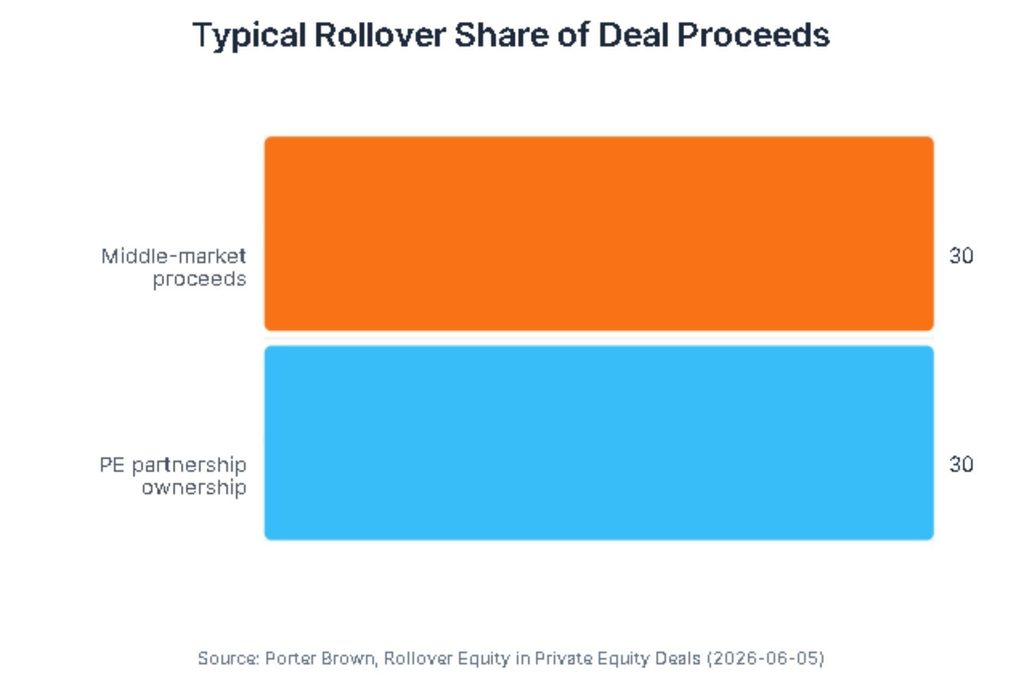
The sizing is not a mystery. Rollover percentages usually land somewhere between 10 and 30 percent of middle-market deal proceeds, and there is no single standard, as Porter Brown’s 2026 advisory explains (Porter Brown, retrieved 2026-10-21). Cash still dominates: the IBBA and M&A Source Market Pulse survey fielded October 1 to 17, 2025, put average cash at close at 81% to 88% across deal sizes, with $5M to $50M deals at 83% cash, 12% seller financing and 1% earnout (IBBA & M&A Source, retrieved 2026-10-21). By the Q2 2026 Market Pulse survey, cash at close ran from 83% to 92%, and 87% of deals over $5M drew at least three offers (IBBA & M&A Source, retrieved 2026-10-21).
Key Takeaways
- Rollover equity means taking part of your sale proceeds in the buyer’s stock, not cash, so you own a minority stake after closing.
- Middle-market rollover percentages usually fall between 10% and 30% of proceeds, and 20% of proceeds is not 20% of post-closing ownership.
- The second payout depends on the exit multiple, the hold period and where your shares sit in the capital stack, not on the entry price alone.
- A rollover can be structured tax-deferred under Section 721 or Section 351, but only if the paperwork is right before you sign.
- Pari passu economics and a liquidation preference review are the terms that decide whether your rolled equity survives a down exit.
Demystifying Rollover Equity in Janitorial M&A
Rollover equity is a seller’s contribution of part of the business’s sale value into the buyer’s acquiring entity in exchange for an ownership interest, instead of taking that portion in cash. You are not keeping your old shares. You are becoming a minority investor in a holding company that a sponsor controls, and your economic rights are set by that company’s operating agreement, not by the corporation you built.
The tax treatment is where founders get surprised. Section 351 of the Internal Revenue Code recognizes no gain or loss when property is transferred to a corporation solely for stock and the transferors control the corporation immediately after, with control defined by reference to Section 368(c) (26 U.S.C. §351, retrieved 2026-10-21). A founder selling 80 percent of a cleaning company to a sponsor cannot meet that test, so the corporate route usually produces boot and taxable gain under §351(b). IRS Revenue Ruling 2003-51 restates both rules and confirms that a prearranged transfer of the received stock does not automatically break control when an alternative qualifying form existed (IRS, retrieved 2026-10-21).
Section 721 of the Internal Revenue Code has no control requirement: no gain or loss is recognized when property is contributed to a partnership for an interest in it, with an exception for partnerships that would be investment companies if incorporated (26 U.S.C. §721, retrieved 2026-10-21). That asymmetry is why most sponsor rollovers run through an LLC or holdco structure. The structure is not cosmetic. As Sadis & Goldberg’s analysis puts it, a cash sale followed by a reinvestment is a taxable sale, and the firm’s worked example shows a 15% rollover in a §721 structure preserving $1.275 million of taxable gain on a $10 million business (Sadis & Goldberg LLP, retrieved 2026-10-21).
The rollover equity conundrum that tax counsel keep warning about is sizing: Dykema and Polsinelli’s practitioner analysis puts rollover interests at 5 to 30 percent of overall ownership in the buyer partnership’s profits and losses, and notes they may exceed 50 percent in some cases (Dykema / Polsinelli, posted 2024-12-26). Neither range is measured data. Both are the ranges deal counsel work from, and Porter Brown flags the denominator problem directly: a 20% rollover of proceeds is not 20% post-closing ownership once the sponsor’s preferred capital and management incentive pool are counted.
For a California founder weighing selling a commercial cleaning business to private equity, the practical question is which structure the buyer proposes and whether your contribution is stock or an LLC interest. Ask for the entity chart and the operating agreement before the letter of intent hardens.
What Janitorial Rollover Terms Look Like in the Lower Middle Market
Lower-middle-market cleaning deals tend to cluster around a recognizable pattern, and knowing the pattern helps you spot when a buyer is asking for more than the market. Based on deal terms our team at Dream Business Brokers sees across commercial cleaning transactions in this revenue band:
- Rollover percentage. Most founders in the $1M to $50M revenue range are asked for 10% to 25% of proceeds, with 15% to 20% the most common landing zone. Offers outside that band usually signal something else at work: a buyer who wants 30% or more is often paying a full price and asking you to fund the gap, while a buyer who wants 5% is telling you your post-close role matters less than your contract book.
- Founder retention. Expect a 24- to 36-month transition, with the first twelve months operationally heavy and the remainder advisory. The work concentrates on three things: keeping named accounts from walking, keeping key supervisors and route leads from leaving, and keeping registration, training and wage compliance clean through the change of control.
- Hold period before the second bite. Platform sponsors in this sector typically underwrite a four- to seven-year hold, and the current market runs toward the longer edge. Budget for five to seven years and treat anything faster as a bonus, not a plan.
These are market observations, not published statistics, and every deal is negotiated on its own facts. But a founder who walks into the LOI meeting already knowing the pattern is a founder who negotiates from knowledge instead of hope.
- 🔗 The California Founder’s Guide to Exiting a $2M-$25M Commercial Cleaning & Janitorial Business
The Math Behind the “Second Bite” (Multiple Expansion)
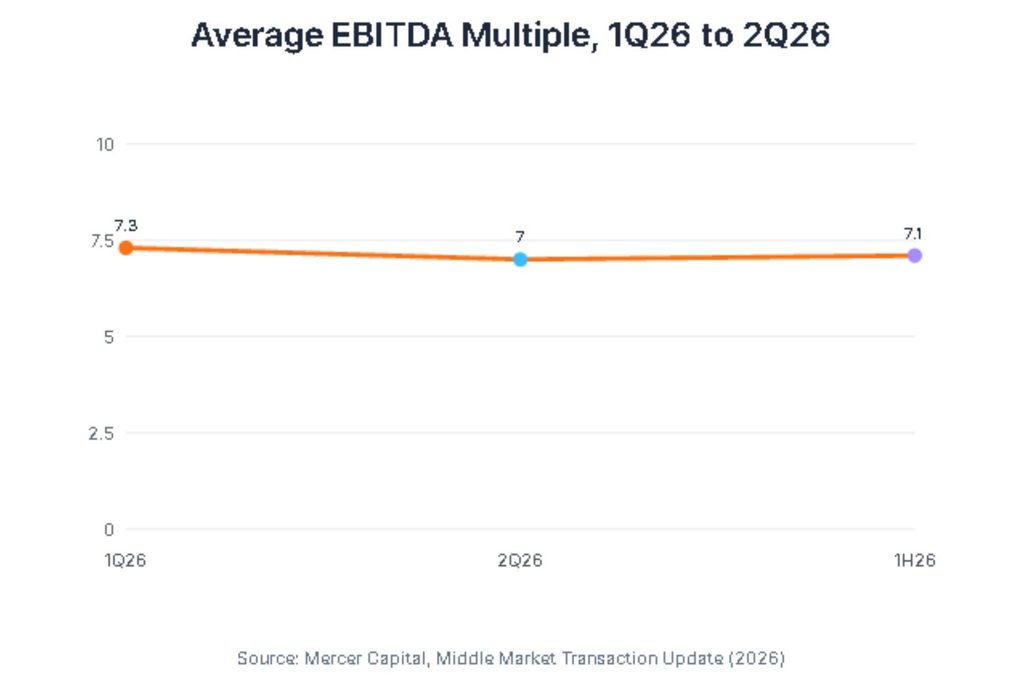
The second bite works when the buyer sells the platform at a higher multiple than it paid, and the arithmetic is straightforward enough to model before you sign. GF Data’s quarterly middle-market reports put the average purchase price at 7.5x trailing twelve-month adjusted EBITDA in Q3 2025, up from 6.9x in Q2 2025 across 66 completed transactions (GF Data, retrieved 2026-10-21). The more recent read is lower: GF Data’s transaction data, compiled by Mercer Capital, shows 7.0x in 2Q26, 7.1x for 1H26, and business services holding at 7.5x across 85 transactions in 2Q26 (Mercer Capital, retrieved 2026-10-21).
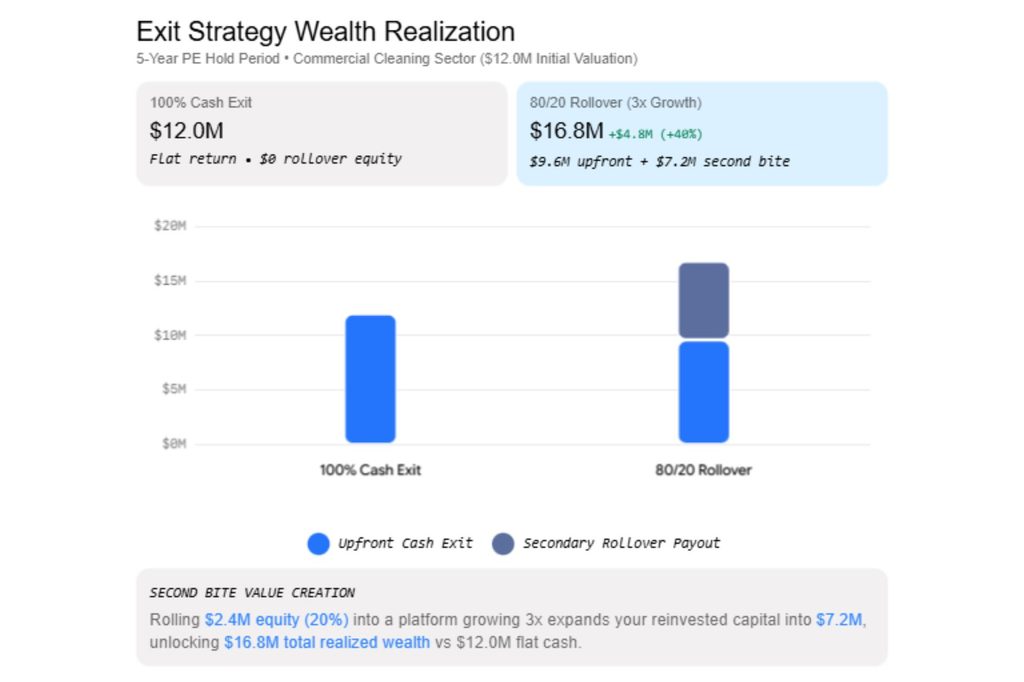
Run the model on a representative $12 million cleaning business with $1.85 million of adjusted EBITDA, using an illustrative janitorial deal structure of 6.5x EBITDA, 78% cash, 12% rollover, 5% seller note and 5% earnout (Ad Astra Equity, retrieved 2026-10-21). That is a $12.03 million enterprise value. An all-cash exit at that price nets you roughly $9.4 million after the note and earnout are collected. A 12% rollover puts about $1.44 million of value into buyer stock, and if the platform exits five years later at the 7.5x business-services average on $2.4 million of grown EBITDA, your share of that $18 million enterprise value is roughly $2.16 million before the sponsor’s preference and fees. The second bite is real, but it is a 50% uplift on the rolled slice, not a doubling.
| Line item | All-cash exit | Rollover exit |
|---|---|---|
| Enterprise value at 6.5x | $12.03M | $12.03M |
| Cash at close (78%) | $9.38M | $8.26M |
| Rolled equity (12%) | $0 | $1.44M |
| Seller note and earnout (10%) | $1.20M | $1.20M |
| Exit value of rolled slice at 7.5x | n/a | ~$2.16M |
| Net difference | baseline | +~$0.72M, before preference and fees |
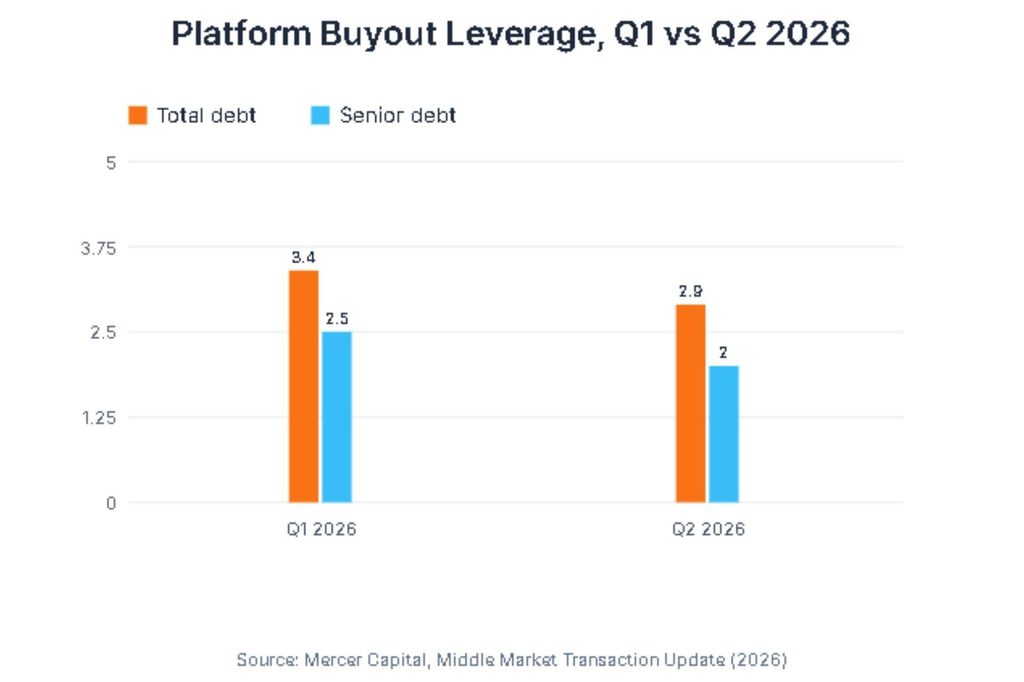
The downside case is where janitorial roll-up multiple expansion stops being a story. If the platform exits at 6.0x on flat EBITDA, the enterprise value is $11.1 million, and after a 1x participating preference and accrued dividends, the common slice you own can be worth less than the $1.44 million you contributed. If the exit is at 5.0x on declining EBITDA, the common can go to zero while the sponsor’s preferred is made whole. Mercer Capital’s 3Q 2026 update shows why leverage matters here: average total debt for platform buyouts fell from 3.4x to 2.9x TTM adjusted EBITDA between Q1 and Q2 2026, and senior debt coverage fell from 2.5x to 2.0x (Mercer Capital, retrieved 2026-10-21). Less debt ahead of you is better for your common, and the trend is moving your way.
Timing is the last variable. McKinsey’s 2026 private markets report puts the average holding period for buyout portfolio companies at 6.6 years in 2025, against a 6.1-year average for 2011 to 2020, measured as the average age of companies still held (McKinsey & Company, February 2026). Plan on waiting most of a decade for the second bite of the apple business sale, and model the downside before you count the upside.
🔗 Why Commercial Contracts Dictate Cleaning Valuations: Escaping the 2x Residential Multiple
Aligning Incentives: Why Buyers Insist on “Skin in the Game”
Buyers want your equity in the deal because it keeps you working through the transition and gives them a seller who has something to lose if the platform underperforms. That is the honest version of “skin in the game.” The sponsor also gets to buy a larger company with less cash, which is the structural reason rollover exists at all.
The buyer type matters more than most founders realize. When the SBA changed its treatment of retained minority stakes on June 1, 2025, the rule that treats a retained minority stake as a continuing ownership interest became a deal-killer for small sellers: a seller retaining equity, even under 20%, has to personally guarantee the loan for two years, and advisors surveyed by IBBA and M&A Source called it a reversal that effectively eliminates the viability of seller-retained equity in SBA-financed deals (IBBA & M&A Source, fielded October 2025). If you want a rollover, your buyer is almost certainly a private equity sponsor, not an individual acquiring with a 7(a) loan. That single fact reframes the whole negotiation: you are not selling to a person who will keep your crew, you are selling into a janitorial roll-up where your contracts become part of a larger platform.
What the sponsor is actually buying is your conviction. A founder who rolls 20% to 30% is telling the buyer that the commercial contracts will stick and the business will keep growing without the founder on the night shift. That signal is worth real money to a sponsor underwriting a platform, because the biggest risk in a janitorial roll-up is that the accounts were personal relationships rather than transferable contracts. Your rollover is the buyer’s hedge against that risk.
Your daily life changes too, and this is the part burnt-out founders underrate. The dispatch board moves to a regional manager, and you move to a strategic advisory or business development seat. Instead of managing floor buffer inventory or chasing call-outs at 11 p.m., you spend your time on the relationships you already built: walking into the property manager’s office you have known for a decade and pitching the platform’s full service line. You keep the community access and lose the liability of running the night shift. That is the lifestyle change a rollover buys you, and it is worth writing into the transition services agreement rather than leaving to goodwill.
Here is how that plays out in practice. Consider an illustrative (not actual client) scenario: a California janitorial founder with $9 million in revenue and $1.3 million of adjusted EBITDA sells to a regional platform at 6.5x. The LOI calls for 75% cash, 15% rollover and a 10% earnout tied to contract retention over twelve months. The founder rolls roughly $1.27 million into common units and signs a two-year transition services agreement covering account handoffs, not night-shift management. Two of the top five accounts are personally held relationships, so the earnout is the real test of transferability. At a 7.5x exit on $1.6 million of EBITDA four years later, the common slice is worth about $1.44 million before fees, a modest gain; at 5.5x on flat EBITDA, the preferred is made whole and the common is worth less than the founder contributed. Same deal, opposite outcomes, decided entirely by the terms above.
California adds a diligence layer that buyers will price. Under California’s Property Service Workers Protection Act, every janitorial employer must register with the Labor Commissioner, renew annually at a $500 fee, and provide biennial in-person sexual violence and harassment prevention training under Labor Code §1429.5, with covered workers including independent contractors and franchisees (California DIR, retrieved 2026-10-21). A buyer who finds an unregistered subcontractor crew will reprice the deal or walk, and that repricing comes out of your proceeds before the rollover is even sized. Clean registration and training records are not paperwork; they are the difference between a sponsor paying your number and a sponsor discounting it.
The “will I still run the night shift?” objection has a contractual answer. Insist the transition services agreement names the services, the hours, the limits and the escalation path, and tie it to the letter of intent’s stated intent. Vague consulting roles are how founders end up working full time for a sponsor while holding a minority stake with no board seat. The same discipline applies to the equity itself: a rollover that survives volatility needs terms that protect your position when the platform stumbles, which is where the fine print on dilution and preference stacks decides whether your second bite is real.
- 🔗 The Operations Manager Bottleneck: How Owner-Dependent Dispatching Kills Janitorial Deals
The Fine Print: Protecting the Rollover from Dilution
Your rolled equity sits behind debt and behind the sponsor’s preferred stock, and the liquidation preference waterfall decides who gets paid first. Mayer Brown’s private placement materials explain the mechanics: the preference is paid on liquidation or a deemed liquidation event such as a merger, sale of substantially all assets or change of control before common receives anything; non-participating preferred takes the greater of its preference or as-converted common value, participating preferred takes its preference, and then shares pro rata with common, and preferences may run 1x or 1.5x to 2x of invested capital with cumulative dividends adding to the stack (Mayer Brown, May 2025). Investors also typically hold a veto over issuance of securities senior to or pari passu with the preferred, which is why pari passu rollover equity protections are the term to negotiate, not a courtesy to request.
The tax calendar runs on its own clock. A Section 83(b) election filed within 30 days moves the income inclusion to the transfer year on the excess of fair market value over the amount paid and may not be revoked except with IRS consent (26 U.S.C. §83, retrieved 2026-10-21). The official filing vehicle is IRS Form 15620, Section 83(b) Election, revised April 2025, which confirms the 30-day deadline and adds that under IRC §7503 a postmark by the next business day is timely when day 30 falls on a weekend or holiday (IRS, retrieved 2026-10-21). Miss it and the tax hits at vesting, when the value may be higher, and the cash to pay it may not exist.
The qualified small business stock rules in Section 1202 provide an exclusion of 50% at three years, 75% at four years and 100% at five or more years, with a per-issuer cap of the greater of the applicable dollar limit or 10 times basis, and original-issue stock required (26 U.S.C. §1202, retrieved 2026-10-21). Stock acquired on or before that date carries a $10,000,000 cap and a longer holding requirement, so the acquisition date decides which rule applies to your shares.
California diligence can also reach your rolled equity through the operating company. California’s ABC test presumes every worker is an employee and puts the burden on the hiring entity to prove all three prongs, with AB 5 applying it to most Labor Code provisions from January 1, 2020 (California DIR, retrieved 2026-10-21). Willful misclassification carries civil penalties of $5,000 to $25,000 per violation under Labor Code section 226.8 (California DIR, retrieved 2026-10-21). The state minimum wage of $16.90 an hour that took effect January 1, 2026 sets the floor, and where a local ordinance is higher, the employer must pay the local rate (California DIR, retrieved 2026-10-21). A misclassification finding after closing can trigger indemnity claims that eat the rolled equity you were counting on.
- 🔗 The AB 5 Diligence Minefield: Cleaning Up Worker Classification Before You Sell
Structuring the Deal with Stewardship
The earned takeaway is that rollover equity for cleaning founders is a structuring decision, not a valuation decision. The multiple you negotiate today matters less than the class of stock you receive, where it sits in the waterfall, whether your economics are pari passu with the sponsor’s, and whether the tax election is filed within 30 days. Model the downside at 5.0x and 6.0x before you accept the upside story at 7.5x.
No obligation, no listing, just the model before you sign.
- 🔗 Partnering with Vinil Ramchandran: Stewardship for the Lower Middle Market Cleaning Exit
FAQs
Usually 10% to 30% of your proceeds, and no rule fixes the number. In middle-market private equity deals, rollover percentages usually land somewhere between 10 and 30 percent, with no single standard (Porter Brown, retrieved 2026-10-21). Tax counsel describe the outer edge as 5% to 30%, occasionally past 50% (Dykema, 2024-12-26). For rollover equity for cleaning founders, the figure is negotiated, not published.
No. A 20% rollover of sale proceeds is not 20% post-closing ownership, because preferred capital, the management pool and co-investors all sit in the denominator (Porter Brown, retrieved 2026-10-21). Ask for the closing cap table in dollars before you sign.
At the sponsor’s next exit, which is usually several years away. The second bite of the apple business sale depends on janitorial roll-up multiple expansion: the platform buys at one multiple, adds contracts and density, and sells at a higher one, and your rolled stake shares that gain. Your operating agreement should name the exit triggers and any put option.
Not if the deal is built as a tax-deferred contribution. Section 721 of the Internal Revenue Code lets you contribute property to a partnership for an interest without recognizing gain, and it has no control test (26 U.S.C. §721, retrieved 2026-10-21). A cash sale followed by a reinvestment is a taxable sale, so sequence and entity type decide the outcome (Sadis & Goldberg, retrieved 2026-10-21). A stock rollover can also fail the control test in Section 368 (26 U.S.C. §368, retrieved 2026-10-21).
Yes, in a bad exit. The liquidation preference waterfall pays preferred before common on a deemed liquidation event, and participating preferred takes its preference and then shares pro rata with common (Mayer Brown, May 2025). Pari passu rollover equity protections, board access and a put option are what you negotiate to narrow that gap.
Warning: Common equity in a leveraged platform can go to zero, and your money stays locked until the sponsor exits.
Rarely, if that buyer uses an SBA loan. Since June 1, 2025, a seller who retains any equity is treated as a continuing owner and must personally guarantee the loan for two years (IBBA & M&A Source, retrieved 2026-10-21). Selling a commercial cleaning business to private equity is usually the only route that lets you roll.
Only if the terms protect you. Cash still dominates: average cash at close ran 81% to 88% across deal sizes in Q3 2025 (IBBA & M&A Source, retrieved 2026-10-21). Rollover equity for cleaning founders makes sense when you get pari passu economics and governance, and not when you are handed common stock and a story.
