

Scaling vs. Selling a California Janitorial Business
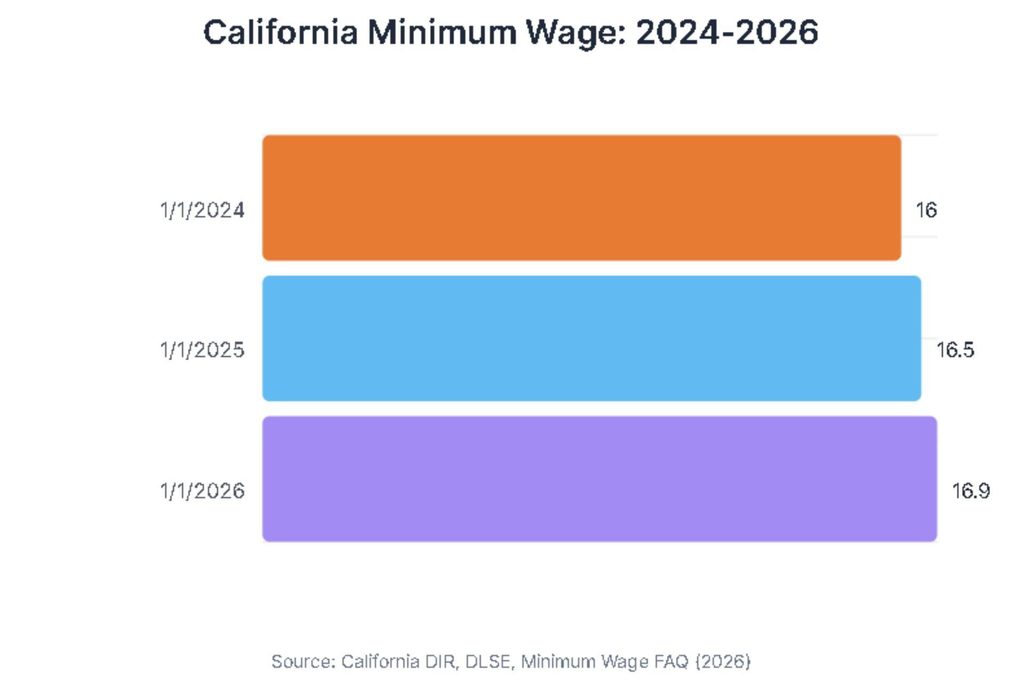
California’s wage floor has moved three times in three years, from $16.00 an hour on January 1, 2024, to $16.50 on January 1, 2025, and to $16.90 on January 1, 2026, for every employer regardless of size (California Department of Industrial Relations’ minimum wage schedule). That schedule is the floor, not the ceiling: where a city or county has adopted a higher rate, the employer must pay the local wage, and the state’s own FAQ says so plainly. For a founder running $5M to $15M of commercial cleaning contracts, the question is no longer whether labor costs rise. It is whether the next dollar of revenue pays for itself, and whether the business is worth more in your hands or in someone else’s. This is the arithmetic behind scaling a commercial cleaning business in California against selling it, run side by side.
Key Takeaways
- California’s state minimum wage reached $16.90 an hour on January 1, 2026, and local ordinances can set a higher floor that overrides it (DIR).
- Field labor is the dominant cost line: 62.5% of building service contractors surveyed reported labor at 51% or more of revenue (ISSA/BSCAI).
- Measured cleaning-business sales data and broker-quoted lower-middle-market multiples sit in different size bands and should never be blended into one valuation.
- Scaling consumes working capital faster than it produces it; selling transfers the labor headache and the float to a buyer with cheaper capital.
- The decision turns on a handful of measurable thresholds, not on how tired you feel in month nine.
The Vise of the California Labor Market
The wage floor is only the first line of the cost stack. Paid sick leave accrues at one hour for every 30 hours worked, with at least 40 hours or five days usable per year since January 1, 2024, and an accrual cap of 80 hours (paid sick leave under Labor Code 246). Workers’ compensation adds a second line: WCIRB’s advisory pure premium rate for class 9015 was $4.45 per $100 of payroll as of September 1, 2025 (WCIRB’s advisory pure premium rate for class 9015). Neither line shrinks when you win a new building./
Then there is the compliance layer that most owners discover late. Any employer with at least one covered worker, or that engages covered workers by contract, subcontract, or franchise, must register annually with the Labor Commissioner’s Office and pay a $500 application fee and a $500 renewal (janitorial registration with the Labor Commissioner). The same page defines a covered worker as anyone working predominantly as a janitor, “whether as an employee, independent contractor, or a franchisee.”
Put those together and the California minimum wage impact on cleaning companies is not a single number on a payroll report. It is a compounding cost structure that arrives whether you grow or stand still. The founder who reached $10M by out-hustling the market now finds that the same hustle produces thinner margins, more personal guarantees, and less sleep. That is the vise. The rest of this article is about which way out of it makes financial sense.
The Danger of “Revenue Vanity”
Revenue growth and profit growth diverge in labor-heavy businesses, and the divergence is measurable. In the ISSA/BSCAI contractor benchmarking study, 62.5% of building service contractors reported field labor at 51% or more of revenue, with 29.69% in the 61% to 70% band and 3.12% above 80% (the ISSA/BSCAI contractor benchmarking study). The survey closed on May 5, 2017, drew 64 qualified questionnaires at a 4% response rate, and relies on self-reported figures, so treat it as a directional benchmark rather than a current census.

Here is the erosion path in plain arithmetic, labeled as illustrative. A contract priced at a 15% margin with labor at 60% of revenue carries 60 cents of labor per revenue dollar. A wage floor that rises roughly 9% over two years, from $15.50 in 2023 to $16.90 in 2026 per the IWC’s official minimum wage rate sheet, adds a small per-hour cost if you absorb it fully. Pass through half and you keep 2.7 cents of margin, which turns 15% into roughly 12.3%. Pass through none and you are near 9.6%. The contract did not change. The margin did.
That is why janitorial business profit margins behave so differently from revenue. And it is why the two paths value the same revenue very differently, as the matrix below shows.
Table 1: Scaling vs. Strategic Sale, Side by Side
| Criterion | Keep Scaling | Strategic Sale or Recap |
|---|---|---|
| Margin trajectory | Compresses with each wage and insurance step unless contracts escalate | Locked at close; buyer absorbs future cost inflation |
| Working capital | Consumes cash as payroll grows ahead of receivables | Released at close; float transfers to buyer |
| Personal-guarantee exposure | Rises with every new line of credit or factoring facility | Retired at close, or reduced to the rollover position |
| Labor liability | Stays on your balance sheet, including classification and registration risk | Shifts to the buyer, subject to diligence findings |
| Owner time | Increases with headcount and geographic spread | Reduces to a governance or transition role |
| Liquidity timing | Deferred until a future sale, at an unknown multiple | Immediate, with rollover equity as the deferred piece |
| Upside retained | 100% of future value, minus the cost of carrying it | Rollover percentage plus earn-out, on negotiated terms |
The matrix is the decision in one page. Scaling wins on retained upside and loses on every risk line. Selling wins on risk transfer and liquidity and gives up the tail. Neither column is better in the abstract.
The Scaling Trap: Outgrowing Your Working Capital
Scaling a commercial cleaning business in California consumes cash before it produces it, and the reason is the gap between payroll timing and receivable timing. You pay cleaners every two weeks. Commercial clients pay on net-30, net-60, or net-90 terms. Every new building you win widens that gap, and the gap is funded by you.
The statutory costs land on the same schedule. The Employment Training Tax runs 0.1% on the first $7,000 of wages, capped at $7 per employee, and State Disability Insurance is 1.3% and employee-paid with no wage ceiling since January 1, 2024 (the EDD’s Employer’s Guide). Registration renewals arrive annually at $500, and the recordkeeping obligation runs three years for names, addresses, daily hours, wage rates, minor ages, conditions of employment, and the pay of other covered workers (the Property Service Workers Protection Act’s registration rules). None of these is large in isolation. Together they are a fixed administrative load that scales with headcount, not with profit.
Advisor Insight: The float is the real product you are selling. When you sell, the buyer is not paying for your mops and your client list. The buyer is paying for a book of contracts and taking on the working-capital cycle that funds them, using capital that costs less than your line of credit. That is why a buyer can pay a multiple for a business that feels cash-poor to you. The float you have been financing personally becomes an asset on their balance sheet.
Factoring invoices is the standard answer, and it works, at a price. The discount rate on factored receivables is a permanent margin haircut on every dollar you bill, and it does not reduce the underlying gap. It converts a timing problem into a recurring cost. Debt is cheaper than equity in the short run, and more expensive in the long run when the debt is personally guaranteed and the wage floor moves again in January.
- 🔗 The California Founder’s Guide to Exiting a $2M-$25M Commercial Cleaning & Janitorial Business
A Worked Example: The $10M Contractor
Here is the whole decision in one modeled business. Every figure below is illustrative; built to show how the arithmetic behaves, not drawn from a specific client, but the mechanics are the ones you would actually run.
Starting position. A California janitorial contractor bills $10.0M a year on multi-year commercial contracts. Field labor runs 62% of revenue, or $6.2M, which sits inside the ISSA/BSCAI range but above the 60% used in the earlier example. After supervision, supplies, insurance, vehicles, and G&A, EBITDA lands at 9.5%, or $950,000. Days sales outstanding is 58 days in a mixed book of net-30 and net-60 accounts.
The working-capital gap. Payroll goes out every two weeks, so labor turns over roughly 26 times a year while receivables turn over about 6.28 times at 58 days. The gap is what you finance:
| Line | Calculation | Amount |
|---|---|---|
| Annual labor cost | 62% × $10.0M | $6,200,000 |
| Labor paid per turnover cycle | $6,200,000 ÷ 26 | $238,462 |
| Receivables outstanding | $10.0M × 58 ÷ 365 | $1,589,041 |
| Working capital tied up | Receivables + one payroll cycle − payables float | ≈ $1,830,000 |
That $1.83M is the float the owner is funding, most of it on a line of credit and a personal guarantee. Now win one more $1M building and every line scales with it: labor rises $620,000, receivables rise about $159,000, and the float rises roughly $183,000, funded before the first client invoice is ever paid.
Three wage steps, one contract. Assume the wage floor rises at roughly the pace of the last three years, about 3% a year, and that the contractor passes through half of it through contractual escalation:
| Year | Labor % of revenue | EBITDA margin | EBITDA |
|---|---|---|---|
| 2026 (baseline) | 62.0% | 9.5% | $950,000 |
| 2027 | 62.9% | 8.6% | $860,000 |
| 2028 | 63.8% | 7.7% | $770,000 |
| 2029 | 64.7% | 6.8% | $680,000 |
Revenue never falls. EBITDA drops 28% over three years. This is the margin squeeze in one table, and it is why an owner who reads only the top line feels like the business is growing while the bank balance disagrees.
What each path is worth. Apply the quoted lower-middle-market convention at the current $950,000 of EBITDA and you get a range of $3.3M to $6.7M, with a mid-point near $5.2M; before any adjustment for concentration, owner dependence, or classification history. Wait three years and apply the same multiple to $680,000 and the mid-point falls to about $3.7M. The multiple did not change; the earnings base did. A buyer paying 5.5x today is paying for the earnings the business produces now, not the revenue it might produce after another wage step.
Run the alternative and the same business looks different. Keep scaling, and the float grows with each contract while the margin compresses under it; so the owner is putting more capital at risk for a smaller percentage return. Sell or recap, and the $1.83M float plus the personal guarantee plus the compounding statutory load all move off the owner’s balance sheet, with rollover equity preserving a share of whatever the next owner actually builds.
The honest caveat: this model assumes flat revenue in the scaling case, which is conservative, and it assumes no contract re-pricing, which is pessimistic. Change either assumption and the crossover moves. That is precisely why the decision should be run on your own four quarters rather than on a hypothetical.
4. The Private Equity Solution: Selling the Labor Headache
Selling a cleaning business to a strategic or financial buyer transfers the labor headache, and the insurance market is telling you what that headache costs. The Insurance Commissioner’s 2026 rate decision adopted an average advisory pure premium rate of $1.65 per $100 of payroll effective September 1, 2026, a 6.6% increase, below WCIRB’s requested 10.4% (the Insurance Commissioner’s 2026 rate decision). The release attributes the pressure to medical, medical-legal, cumulative-trauma, and claims-adjusting costs, and notes that wage growth partially offset them. The rate is advisory: insurers set their own.
Classification is the other half of the insurance story. WCIRB classifies fee-basis janitorial work under class 9008, “Janitorial Services, by contractors,” while class 9015(1) covers building operation for all other employees, and the code a contractor is assigned is a rating outcome, so a misclassified book raises premium after audit (WCIRB’s classification plan). A buyer’s diligence team will read your classification history before it reads your growth chart.
The classification question connects directly to the ABC test. Under Labor Code 2775 through 2787, a worker is an employee unless the hiring entity proves all three prongs, including that the work is outside the usual course of the hiring entity’s business (the ABC test as the FTB restates it). Cleaning a customer’s building is the usual course of a cleaning company’s business. That is the structural problem with a 1099 crew model, and it is the first thing a buyer’s counsel will price.
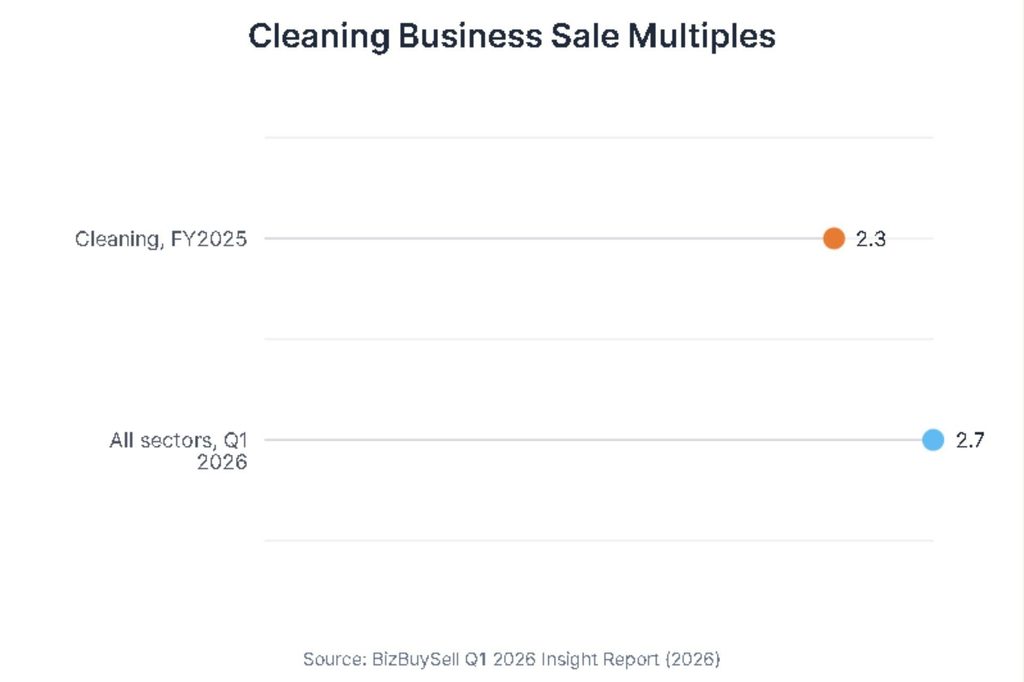
On valuation, the evidence splits into two size bands that must not be blended, and the gap between them is largely a gap in measurement quality rather than a gap in reality.
The measured band is Main Street. BizBuySell’s closed-transaction data for cleaning businesses shows 154 reported sales in full-year 2025, a median sale price of $325,000, median revenue of $424,088, median cash flow of $135,017, and an average cash flow multiple of 2.30x (BizBuySell’s closed-transaction data for cleaning businesses). These are reported closed deals, which makes them the most defensible figures in this article — but they describe businesses that mostly sell for under $1M, so they cannot be extrapolated upward to a $10M contractor.
The band your business sits in is quoted, not measured. Broker-published ranges put lower-middle-market janitorial at 3.5x to 7.0x EBITDA with a median near 5.5x, and cite ABM’s August 2021 acquisition of Able Services at roughly 12.8x adjusted EBITDA as an upper reference point (broker-published multiple ranges). Those figures come with no disclosed dataset, sample size, or adjustment methodology, so treat them as market convention rather than measurement. No verified, methodology-disclosed EBITDA dataset for the $5M to $15M revenue band surfaced in this research, and we would rather say that plainly than dress a convention up as data.
Why the bands diverge is worth understanding even when the numbers are soft. A four-to-five-turn spread between Main Street and lower-middle-market pricing reflects real structural differences: recurring contract revenue with escalation clauses instead of month-to-month work, a management team that runs the nights without the owner, customer concentration that a buyer can underwrite, audited or at least reviewed financials, and a buyer pool that includes institutional capital rather than only individual owner-operators. In valuation terms, those are quality-of-earnings and transferability adjustments, not generosity.
That framing comes from standard practice rather than from a single study. Professional valuation bodies; the American Society of Appraisers (ASA) and the International Business Brokers Association’s CBI body of knowledge — treat the multiple as an output of a normalized earnings base, a risk assessment, and a comparability analysis, not as an input you look up. In lower-middle-market service businesses, the discounts and premiums applied for customer concentration, owner dependence, and contract transferability routinely move the effective multiple by two to three turns in either direction. So when a broker quotes 5.5x, the useful question is not whether that number is right. It is which normalization and risk adjustments produced it, and whether your business qualifies for them.
Advisor Insight: Rollover is a term-sheet problem, not a percentage problem. The pitch sounds simple: roll 20% and you will make more money later, or keep skin in the game and get a higher multiple today. The percentage is the sponsor’s offer, not the analysis. What determines whether rollover equity is worth anything is where it sits in the capital stack and what governance rights come with it. Heavy leverage, or a senior class the sponsor is paid out of first, can turn rollover into a lottery ticket. Negotiate it the way an institutional investor would: pressure-test the capital stack, model the downside case, and insist on governance terms in writing.
The objection that private equity will strip the company deserves a direct answer. A recapitalization is a different structure from a buyout: in a recap you sell a portion of your equity, while in a buyout the investor takes 100% or a controlling stake. If continued involvement matters to you, the recap is the structure that preserves it, and the governance terms you negotiate determine how much of it you actually keep.
- 🔗 The “Second Bite of the Apple”: Rollover Equity Structures for Groth or Burned-out Cleaning Founders
The Tipping Point: When to Stop Grinding and Start Architecting
The decision to keep scaling a commercial cleaning business in California or to start preparing to sell a cleaning business comes down to thresholds you can measure this quarter. When two or more of the warning signals below are live, the arithmetic has already turned and the question is timing, not direction.
Table 2: KPI Thresholds and What They Signal
| Metric | Warning Threshold | What It Signals |
|---|---|---|
| Field labor as % of revenue | Above 65% | Margin compression is structural, not a bad month |
| Days sales outstanding | Above 60 days | Working capital is being funded by debt or personal guarantees |
| Contract escalation clauses | Absent or capped below CPI | Every wage step is absorbed, not passed through |
| Personal guarantees outstanding | More than one facility | Risk concentration that a buyer will price into the deal |
| Registration and records status | Any gap in the three-year record set | Diligence exposure under the Property Service Workers Protection Act |
| Worker classification | 1099 crews performing core cleaning | ABC test prong B exposure that survives closing |
| Owner hours in operations | Above 50 per week | The business is you, which caps the multiple |
Two objections surface at this point, and both deserve a straight answer.
“My 1099 crews are fine.” They are not fine for registration purposes. A covered worker includes independent contractors and franchisees, and the statutory employer definition contains no exceptions for PEOs or nonprofits, reaching entities that provide janitorial services by subcontract or franchise (janitorial registration with the Labor Commissioner). The registration obligation and the ABC test are separate questions, but neither one goes away because the crew is paid on a 1099.
“I’ll sell when margins recover.” Margins do not recover on their own in a market where the wage floor resets every January and the insurance rate resets every September. Waiting for recovery usually means waiting through another wage step, another renewal cycle, and another year of personally guaranteed float. The plateau is the signal.
What Shows Up in Diligence
The thresholds above tell you whether to act. The diligence file tells you what it will cost. Across janitorial transactions, the same handful of findings recur, and they are rarely surprises to the seller — they are things the seller lived with for years and never priced.
The 1099 crew that was always “fine.” A book of contracts staffed by independent contractors shows up as a classification exposure the moment a buyer’s counsel applies the ABC test. The practical consequence in a deal is not usually a lawsuit; it is a purchase-price adjustment, an indemnity escrow, or a requirement that the seller convert the workforce and absorb the cost before closing.
Lapsed or missing registration renewals. Registration is annual and cheap to maintain, which is exactly why it gets missed. A gap in the renewal record turns into a diligence question about every other compliance item, because a buyer who finds one gap assumes the file is incomplete everywhere.
An incomplete three-year record set. The recordkeeping obligation covers names, addresses, daily hours, wage rates, minor ages, conditions of employment, and the pay of other covered workers. Most operators have the payroll data and not the daily-hours data, and reconstructing three years of it after the letter of intent is signed costs time the deal may not have.
Customer concentration. One client at 25% of revenue does not kill a deal. It changes its shape: the buyer wants an earn-out tied to retention, a longer escrow, or a price adjustment. Owners who know their concentration number before diligence starts negotiate better than owners who discover it in a buyer’s opening memo.
One illustrative pattern. Take a contractor in the $8M to $10M range with labor above 63% of revenue and DSO near 70 days. On paper the business is profitable and growing. In practice the owner has been financing a widening float with personally guaranteed debt, and the last two years of margin have gone to servicing it rather than to the owner. In that pattern, the first move is rarely a sale — it is a written re-pricing of the two or three contracts that are dragging the blended labor ratio, followed by a filing cleanup, and then a structured process. The sequence matters more than the speed.
- 🔗 The AB 5 Diligence Minefield: Cleaning Up Worker Classification Before You Sell
Resources for California Janitorial Owners
- DIR, DLSE: minimum wage schedule, paid sick leave FAQ, and janitorial registration guidance at dir.ca.gov/dlse
- EDD: 2026 contribution rates and the Employer’s Guide (DE 44) at edd.ca.gov
- DWC: workers’ compensation information for employers at dir.ca.gov/dwc
- SBA: loan and guarantee program terms at sba.gov
- WCIRB: classification plan and advisory pure premium rates at wcirb.com
- BizBuySell: closed-transaction insight reports at bizbuysell.com/news
- Ad Astra Equity: broker-published janitorial multiple ranges at adastraequity.com
Navigating the Crossroads
The two paths are not opposites. They are two ways of holding the same asset, and the matrix in Section 2 and the thresholds in Section 5 exist to tell you which one your numbers support. If labor is above 65% of revenue, receivables run past 60 days, and your guarantees are stacked, scaling is borrowing against a margin that is already shrinking. If those lines are clean and you have a management team that runs the nights without you, scaling still has room.
What you do Monday morning is narrower than the whole decision. Pull three numbers: field labor as a percentage of revenue for the last four quarters, days sales outstanding across your top ten accounts, and the total of personally guaranteed obligations. If two of the three sit past the thresholds above, the next step is a structured look at what the business is worth today, before another wage step resets the baseline.
A Margin Squeeze and Valuation Assessment does exactly that. It analyzes your labor cost structure, your working-capital exposure, and the strategic-exit path available to you, in one confidential conversation with no obligation and no valuation guarantee attached. Request a confidential assessment and find out whether the next move is to scale, to recapitalize, or to sell.
- 🔗 Partnering with Vinil Ramchandran: Stewardship for the Lower Middle Market Cleaning Exit
Disclosure: this assessment is offered by our brokerage and advisory practice, and it is a lead-generation service rather than an independent appraisal. A certified valuation is a separate engagement with a defined standard of value and a written report.
Frequently Asked Questions
What is the current California minimum wage for janitorial companies in 2026?
The state minimum wage is $16.90 per hour effective January 1, 2026, for all employers regardless of size (DIR). Where a city or county has adopted a higher rate, the employer must pay the local wage instead.
Do I have to register my janitorial business if I use independent contractors?
Yes, if any covered worker performs janitorial services for you. A covered worker includes independent contractors and franchisees, and the employer definition contains no exceptions for PEOs or nonprofits (DIR). Registration costs $500 initially and $500 to renew annually.
How are cleaning businesses actually valued?
It depends on size band. BizBuySell’s full-year 2025 closed-transaction data shows cleaning businesses sold at an average 2.30x cash flow on a median revenue of $424,088 (BizBuySell) — but that is the Main Street band, mostly under $1M, and it does not transfer upward to a $10M contractor. Lower-middle-market janitorial companies are quoted by brokers at 3.5x to 7.0x EBITDA with a median near 5.5x. That range is published without a disclosed dataset, sample, or adjustment methodology, so it is market convention rather than measurement. The multiple you actually achieve will be set by normalized earnings, customer concentration, owner dependence, and contract transferability.
Does selling mean I have to leave the business?
No. A recapitalization lets you sell a portion of your equity while remaining involved, whereas a buyout transfers 100% or a controlling stake to the investor. The governance terms you negotiate determine how much operational control you keep.
How long does a janitorial business sale take?
Confirmatory diligence in lower-middle-market deals typically runs 60 to 90 days after the letter of intent, and the LOI is the starting point rather than the finish line. Customer concentration and disorganized financial records are the two issues most likely to derail a deal. Total time from initial marketing to Closing a deal could take 6 to 9 months.
