

Selling an Owner-Dependent Janitorial Business
The trait that built your janitorial company is the trait that will price it. Founders who dispatch every night crew, hold every property manager relationship, and personally absorb every client escalation built something real. That same centrality is what a buyer discounts when you sell an owner-dependent janitorial business. The market is not waiting: Baby Boomers made up 59% of sellers in brokered deals in Q3 2025 (IBBA Market Pulse, 2025). You have a 12-24-month window to convert a founder-run shop into a management-run one.
Owner-dependent dispatching is the specific mechanism. Every schedule change, supply order, and call-off routes through you, so the company’s operating rhythm exists only while you are awake and reachable. Buyers read that as risk before they read it as revenue.
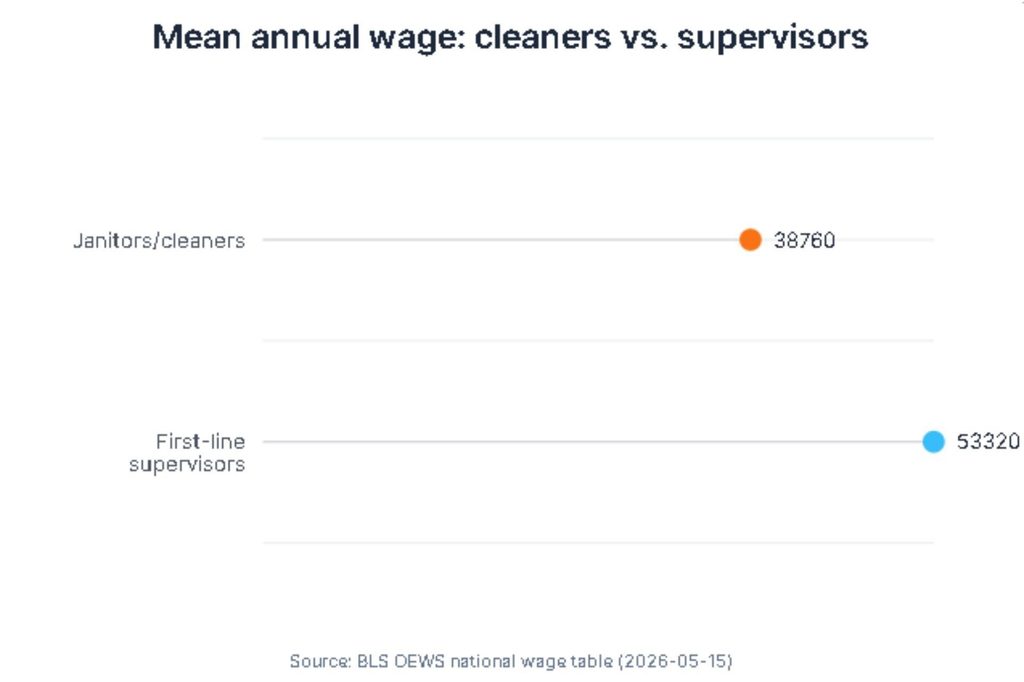
The fix is not a personality change. It is a management layer: supervisors with real decision rights, documented systems a third party can audit, and a written record that the business runs without you. The cost is measurable. First-line janitorial supervisors earn about 37% more than the cleaners they direct, a $14,560 annual premium on national mean wages (BLS OEWS, May 2025). That premium is the cheapest line item in the exit.
The Valuation Penalty: “Key-Man Risk” in Due Diligence
Key-man risk in commercial cleaning is priced as a haircut to enterprise value, not as a vague worry. A buyer prices the business on its existing financials, then reduces that pricing by 15%, 20% or more to reflect the absence of the owner (Damodaran, Key Person(s) Valuation). The same note attributes to Shannon Pratt a widely used practitioner range of 10% to 25%, left almost entirely to appraiser discretion.
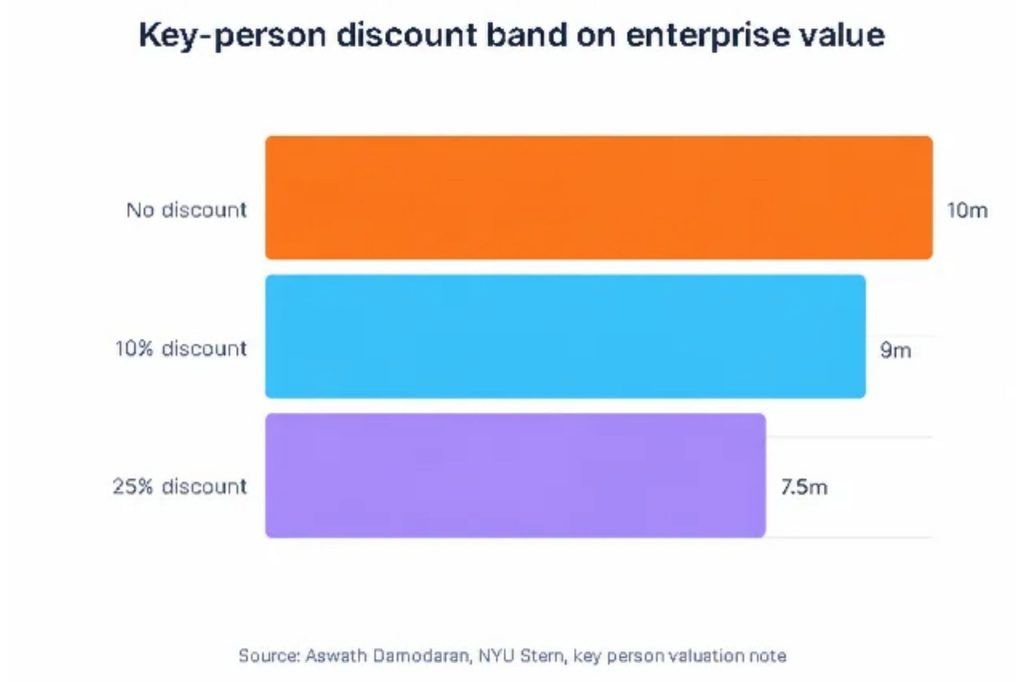
The mechanism matters more than the number. The haircut lands after the pricing, not inside the multiple. A buyer does not quietly apply a lower multiple to your earnings; they accept your multiple and then subtract the key-person adjustment as a separate line. That is why sellers who negotiate hard on the multiple still lose money at the closing table.
The doctrine behind it is old and still current. The IRS ruled in 1959 that losing the manager of a one-man business can depress value when no trained successor exists, and listed “the absence of management-succession potentialities” among the pertinent factors (Rev. Rul. 59-60, 1959). No percentage appears in the ruling. The same ruling says value is not depressed when competent management can be hired on the consideration paid for the former manager’s services. The discount is conditional, and the condition is your management layer.
Janitorial business valuation multiples follow the same size logic. Brokered deals split their valuation basis at $2 million in revenue: below that line, multiples of seller’s discretionary earnings; above it, multiples of EBITDA (IBBA Market Pulse, Q3 2025). The published medians are 5.0x under $500K, 4.5x at $500K to $1M, and 5.3x at $1M to $2M on SDE, then 6.5x EBITDA at $2M to $5M. Those are deal-size medians across industries, drawn from brokered deals reported to IBBA’s quarterly survey, not a janitorial-specific table, and no public janitorial median exists.
| Pricing basis | Typical range | What moves it |
|---|---|---|
| SDE multiple (under $2M revenue) | 4.5x to 5.3x median | Small deal, cash at close, buyer assumes owner stays |
| EBITDA multiple ($2M to $5M revenue) | 6.5x median | Recurring contracts, management team, clean books |
| Key-person discount | 10% to 25% of indicated value | Applied after pricing, not inside the multiple |
Where the buyer is a private equity platform, the bar rises again. Trade coverage of private equity in janitorial puts platform deals near $25 million in revenue and $3 million in EBITDA, with add-ons from about $1 million (CleanLink, 2024). Platform buyers nearly always require a CEO who stays on with equity, which is precisely the structure an owner-dependent dispatching business cannot supply. The SBA still calls a janitorial firm small up to a receipts-based size standard (13 CFR Part 121), so a $8M shop sits inside the small-business definition while sitting well below the platform threshold. That middle ground is where the discount bites hardest.
- 🔗 The California Founder’s Guide to Exiting a $2M-$25M Commercial Cleaning & Janitorial Business
The “Flight Risk” of Property Managers and Supervisors
The strongest objection is that the relationships are the value, and the HOA board renews because of you. Buyers do not pay for relationships that walk out the door with the seller. Rev. Rul. 59-60 grounds goodwill in earning capacity, and owner-dependent goodwill may not transfer (Rev. Rul. 59-60, 1959). Your class-A office park contact is an asset of the enterprise only if someone other than you can service it after closing.
Deal terms show buyers pricing exactly that uncertainty. Leaving life sciences aside, 24% of deals completed in 2025 included an earnout, and the share rises as deal size falls: 30% of deals valued at $50 million or less and about 35% of lower-middle-market deals under $25 million (SRS Acquiom, 2026 M&A Earnout and Milestone Trends, 2026). The median potential earnout in lower-middle-market deals is close to 57% of the amount paid at close, versus 34% across all deal sizes. Small brokered deals still close almost entirely in cash: 86% cash at close and 1% earnout for $1M to $2M transactions (IBBA Market Pulse, Q3 2025). The earnout is the buyer’s tool for the segment where people matter most.
Warning: An earnout tied to supervisor retention converts your payout into a retention bet you no longer control. If your night supervisor leaves in month four and the account follows, the earnout does not pay, and the buyer’s remedy is already written into the agreement.
Financing rules tighten the same screw. The SBA’s current SOP requires the seller to exit as an operational decision-maker, with transition assistance only under a written consulting agreement capped at 24 months (SBA lender resources, effective 1 October 2026). A buyer using SBA money cannot keep you in the dispatch chair. California adds a withholding duty: a California buyer must hold back enough of the price to cover the seller’s unpaid taxes unless it obtains a clearance certificate (Cal. Code Regs. tit. 18 §1334). Neither rule cares how good your relationships are.
Worker classification is the quietest flight risk. The state presumes a worker is an employee unless all three prongs of the ABC test are met (California LWDA), and janitorial work is expressly carved out of the referral-agency exception (California DIR). A 1099 night crew doing the same work you sell to customers fails the second prong almost by definition. A buyer’s diligence team will find it, and the finding becomes a price chip or a walk.
This is not legal advice. Consult a qualified attorney for your specific situation.
- 🔗 Why Commercial Contracts Dictate Cleaning Valuations: Escaping the 2x Residential Multiple
The Operational Fix: Building the Management Layer
The cleaning company management structure that survives diligence has three properties: named decision-makers, documented systems, and a cost the multiple gap can absorb. Start with the arithmetic. Cleaners average $38,760 a year (BLS OEWS, May 2025), with first-line janitorial supervisors earning more. On an $8M shop with roughly 8% to 12% EBITDA margins, the benchmark trade sources cite (CleanLink, 2024), EBITDA runs $640,000 to $960,000. Two supervisors cost about $29,120, or roughly 3% to 4.5% of EBITDA.
Now the other side. A 20% key-person haircut on a $1.2M enterprise value is $240,000, more than eight years of that supervisor premium. The hire is not an expense against the exit; it is the cheapest insurance the deal has.
The decision-rights matrix is the artifact that proves the layer exists. Write it before you hire, and give each row a default owner, a spending limit, and an escalation trigger.
| Decision | Default owner | Spending limit | Escalation trigger |
|---|---|---|---|
| Night crew call-off and reassignment | Night supervisor | None | Client contract penalty risk |
| Supply orders and equipment repair | Area supervisor | $500 per order | Repeat failure at one site |
| Client complaint and service recovery | Account supervisor | One free service visit | Contract value above 5% of revenue |
| New account pricing | Operations manager | Within rate card | Any deviation from rate card |
| Hiring and termination | Operations manager | Budgeted headcount | Termination with legal exposure |
Documented systems are what a buyer can verify without trusting you. Every California employer needs a written injury and illness prevention program with a named person responsible, periodic inspections, and training whenever employees receive a new assignment (Cal/OSHA IIPP). That named person is a management-layer role whether or not you have called it one. ISSA’s CIMS certification is audited by an independent assessor, so a buyer can verify the system rather than take your word (ISSA CIMS).
Pro Tip: Build the dispatch decision-rights matrix before you post the Operations Manager job. The matrix defines the role, prices it, and gives the new hire authority on day one instead of a six-month shadow period.
Financing capacity is not the constraint it was. The SBA announced on May 18, 2026 that it would double the cumulative 7(a) plus 504 ceiling to $10 million, and the change took effect on July 4, 2026 (SBA news release, May 2026). The new ceiling is a combined cap, not a bigger single loan: each program still tops out at $5 million (SBA lender resources), and the borrower generally takes the 7(a) piece first. A buyer for an $8M janitorial firm now has more room to finance the acquisition than at any point in the program’s recent history, which raises the number of buyers who can clear your price.
- 🔗 The AB 5 Diligence Minefield: Cleaning Up Worker Classification Before You Sell
Protecting Your Crews by Stepping Away
Stepping back is not abandonment, and the evidence says the opposite of what founders fear. The most valuable key people make themselves dispensable over time by finding successors and building teams who can replicate what they do, which reduces their key-person value and raises the organization’s (Damodaran, Key Person(s) Valuation). The trade is a lower personal premium for a higher enterprise value, and if you own enough of the enterprise, you end up better off.
The two-week test is the diagnostic. If you cannot step away from the business for two weeks without the operation stalling, you have an owner-dependency problem, and buyers price it before they price anything else. Run the test in a quiet month first. Hand dispatch to a supervisor, route escalations to a second name, and log every decision that came back to you anyway. That log is your build list.
A typical pattern looks like this. A seller with roughly $4 million in revenue hands dispatch to an area supervisor and goes quiet for two weeks. The log fills with 40 or so calls, and almost none of them are emergencies: supply orders the supervisor could place, a weekday schedule swap waiting on a formality, one property manager who simply would not accept a new point of contact. Only that last item required the owner. The rest were decisions the owner had never formally delegated, which is the whole diagnosis in one page.
Crews are safer under a management layer, not less safe. The IIPP requirement names a person with authority to implement the program and requires training whenever employees receive a new assignment (Cal/OSHA IIPP). A supervisor who owns that role gives a night cleaner a named person to report a hazard to at 2 a.m., which is a retention mechanism as much as a compliance one. Turnover is where account continuity dies, and no source in this set measures janitorial turnover, so treat crew stability as a diligence question your buyer will ask and your records should answer.
California’s successor liability rule gives you a second reason to clean the books before you sell. A buyer must withhold enough of the price to cover your unpaid taxes unless it obtains a board certificate of no tax due (Cal. Code Regs. tit. 18 §1334). A clearance certificate in hand at signing removes a withholding fight from closing week.
The 18-month question deserves a direct answer. The management layer is not a three-year transformation. Hiring two supervisors, writing the decision-rights matrix, and documenting the IIPP can be done inside two quarters, and the earnout data shows buyers will pay for a business whose continuity does not depend on one person (SRS Acquiom, 2026 M&A Earnout and Milestone Trends, 2026). What you cannot compress is the record: a buyer wants to see the layer operating across at least four quarters of financials.
Sources and Methodology
The figures above come from three kinds of sources, and it helps to know which is which before you rely on a number.
Valuation ranges. The 10% to 25% key-person adjustment is a practitioner range reported in Damodaran’s work and attributed there to Shannon Pratt; the IRS ruling sets out the principle, not a percentage. The SDE and EBITDA medians are IBBA Market Pulse figures for brokered deals, reported by deal-size band and pooled across industries, because no janitorial-specific median is published. They describe where brokered deals in a size band have been pricing, not a formula that produces your number.
Deal terms. Earnout prevalence and payout statistics come from SRS Acquiom’s private-target studies, which draw on deals where the firm provided services. That sample skews toward larger, professionally advised transactions; the smallest brokered deals, as the IBBA cash-at-close figure shows, rarely include earnouts at all.
Compliance and wage data. Wage figures are BLS national occupational means, not California or metro rates. California rules are cited to the current regulatory or agency text. Local wage levels, union contracts, and county ordinances will move the arithmetic and should be checked for your market before you rely on the cost estimates.
Navigating the Diligence Minefield
The valuation penalty is real; it has a mechanism, and it has a range. A buyer prices your earnings, then subtracts 10% to 25% for the owner who is leaving (Damodaran, Key Person(s) Valuation), and the IRS has treated management succession as a value factor since 1959 (Rev. Rul. 59-60). The offset is written into the same doctrine: competent management hired in the seller’s place keeps value intact.
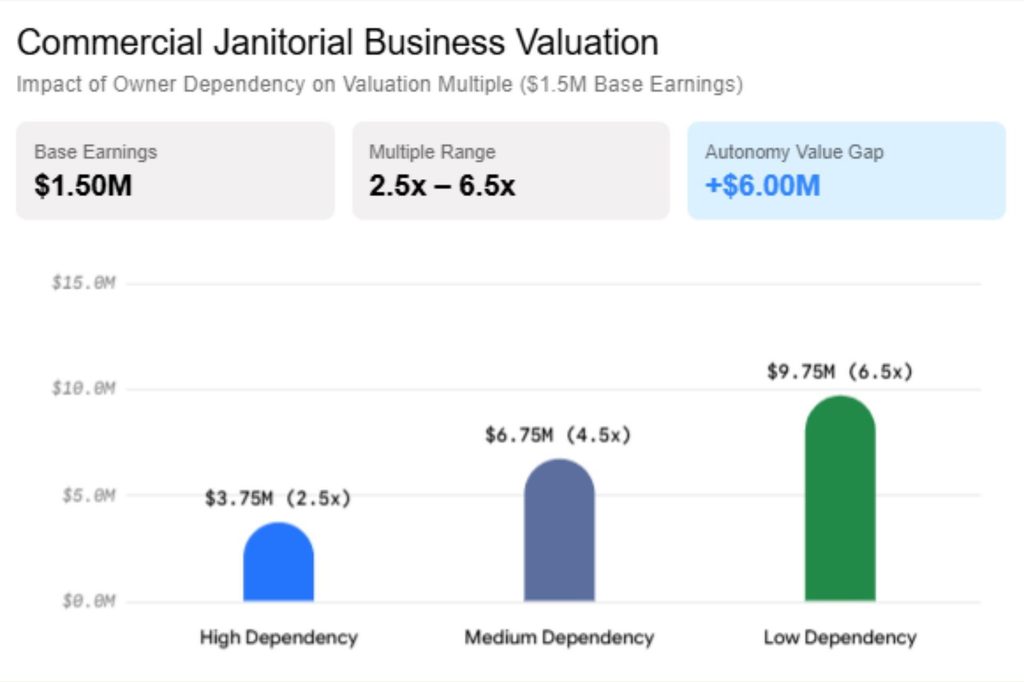
The work is unglamorous and it is bounded. Name the decision-makers, write the matrix, document the systems, and prove the business runs for two weeks without you. Two supervisors cost about $29,120 a year against a haircut that can run into six figures on an $8M shop.
Vinil Ramchandran, an M&A advisor with more than 25 years spanning corporate management and small business ownership, works with California sellers on exactly this transition. Request my confidential assessment before you take a letter of intent you cannot defend.
- 🔗 Partnering with Vinil Ramchandran: Stewardship for the Lower Middle Market Cleaning Exit
About the publisher. Dream Business Brokers is an M&A advisory firm that represents sellers of businesses, including service-oriented companies, and its published guidance treats owner dependency as a pricing problem that lowers offers. The firm earns its fees from sale transactions, so weigh its perspective with that commercial interest in mind. The guidance above does not depend on its services.
