

Lower Middle Market Cleaning Exit Advisor in California
Most cleaning company owners in the $5M to $25M band who test the market hear the same pitch: sign a listing agreement, get a teaser out, wait for buyers. That model works for a restaurant or a retail shop. It struggles with a janitorial business, because the value of a cleaning company sits in its contracts, its crews and its compliance file, and a volume broker rarely has the time to build any of those into a story a buyer will pay for. California’s labor rules make the gap wider. A single misclassified subcontractor can turn a profitable account into a liability, and buyers know it before the owner does.
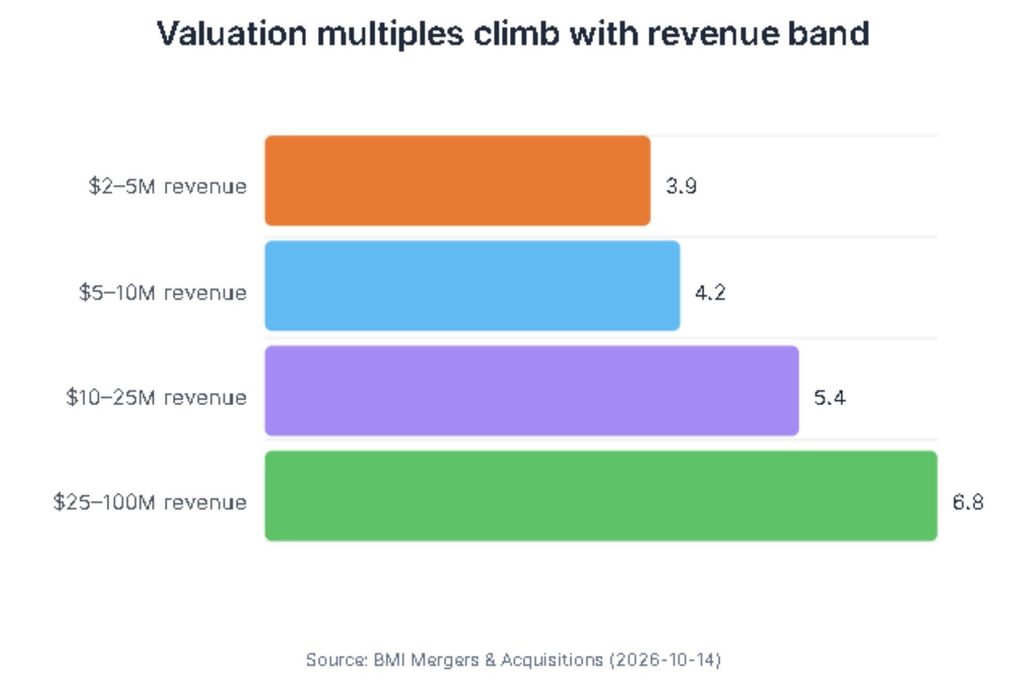
The alternative is stewardship: fewer engagements, more preparation, and an advisor who has read the wage orders rather than a summary of them. The distinction matters most where the numbers are widest: building services companies in the lower middle market have generally sold for 3.5x to 8.0x adjusted EBITDA since 2021, with the $10M to $25M revenue band benchmarking at 5.4x (BMI Mergers & Acquisitions, 2026-10-14). The same dataset puts commercial cleaning and janitorial at a median 4.0x at $2M to $10M revenue. The spread between 4.0x and 5.4x is not luck. It is preparation.
Key Takeaways
- Lower middle market building services companies have sold for 3.5x to 8.0x adjusted EBITDA since 2021, with the $10M to $25M band at 5.4x and commercial janitorial at $2M to $10M revenue at a 4.0x median (BMI Mergers & Acquisitions, 2026).
- California’s ABC test requires a hiring entity to prove all three prongs, so a cleaning company that subcontracts its core service fails prong B on its face (LWDA, 2019).
- PAGA notices averaged about 849 per month in 2026, on pace to exceed 10,000, and 44% of 2026 settlements cover fewer than 200 employees (California Employment Law Report, 2026-07-31).
- A 90-day pre-market architecture, run in three phases, converts owner-dependent revenue into transferable contracts before a buyer ever sees the file.
- The close is a confidential strategy session, not a listing agreement.
The Broker vs. The Steward
The difference between a basic broker and a steward shows up in what each one does before the business is for sale. A volume broker’s economics depend on listing volume, so the work starts at the listing. A steward’s economics depend on the outcome, so the work starts a quarter or more earlier, with the labor file, the contract stack and the dispatch chart. For a California cleaning business, that earlier work is where the multiple is won or lost.
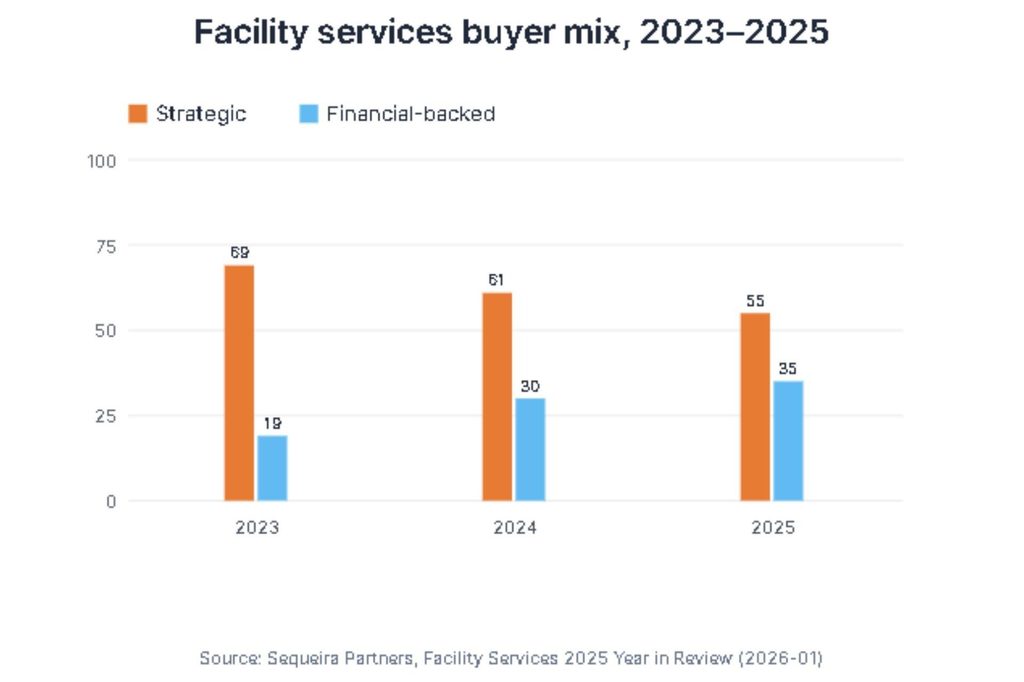
The buyer pool is not the constraint. North American facility services recorded 484 announced transactions in 2025 against 427 in 2024, and private equity remained the most active buyer group, with financial-backed buyers rising from 19% of the mix in 2023 to 35% in 2025 (Sequeira Partners, 2026-01). Janitorial deal volume reached 31 transactions in 2025, up from 24 in 2024, and Meridian IB marks the sector as being in “Phase II (Platform Formation & Growth)” of consolidation (Meridian IB, Spring 2026). Buyers are active. What they discount is a business whose earnings depend on the founder and whose labor practices cannot survive a diligence request.
That is the case for treating the business broker versus M&A advisor question as a question about preparation depth, not about reach. The commercial janitorial segment is projected at roughly $81B in 2026, 89% of a $112B industry, spread across about 1 million U.S. businesses, and more than 70% of revenue sits with regional and local lower-middle-market operators (Three Sixty Seven Advisors, May 2026). A steward who knows that landscape can name the strategic buyers and the platform operators who already own accounts in the same county.
The Pre-Market Architecture (Preparation Over Plugins)
Preparation beats plugins because buyers price what they can verify. A sell-side Quality of Earnings, the pre-sale review that restates reported profit as sustainable EBITDA and documents the reasoning behind every adjustment, is the document that does the verifying. The firm’s stated cost range for one is $20,000 to $90,000, positioned against a $1M to $2M valuation haircut when the earnings story collapses in diligence (Dream Business Brokers, current). For a boutique facilities management M&A advisory engagement, that is the cheapest insurance in the process.
The three phases below run in sequence, and each one has a different owner time cost. Phase 1 is a quick win because the records already exist. Phases 2 and 3 are longer-term shifts that change how the business operates, which is why they belong in California cleaning business exit planning a year out, not a month out.
Illustrative example (not a client result): Picture a 130-crew janitorial company at roughly $9M revenue whose books show one large account billed as a subcontract. In the audit, the invoice label did not survive the work test: the “subcontractor” ran crews on the owner’s schedule, with the owner’s equipment, under the owner’s supervisor. Conversion to W-2 status, with the meal and rest records rebuilt for the prior two years, was the first fix. The second was turning the four largest handshake accounts into written MSAs with change-of-control language. The third was naming a dispatch lead and moving the founder out of the nightly schedule. That is the shape of the work, not a promised outcome; the sequencing is what a steward manages, and the multiple follows the file quality a buyer can verify.
| Phase | What it fixes | Owner time cost |
|---|---|---|
| 1. AB 5 vulnerability audit | Classification, meal and rest records, PAGA exposure | 15 to 25 hours over 3 to 4 weeks, mostly pulling files |
| 2. Contract formalization | Handshake and spot accounts converted to written, recurring MSAs | 20 to 30 hours over 60 to 90 days, mostly client conversations |
| 3. Key-man mitigation | Founder removed from daily dispatch and account ownership | Ongoing, 5 to 10 hours a month for two quarters |
Phase 1: The AB 5 Vulnerability Audit: Financial & Regulatory Scrub
The audit starts with the ABC test, because it is the one rule that can reprice a cleaning company overnight. A worker is an employee unless the hiring entity proves all three prongs: that the worker is free from control and direction in contract and in fact, performs work outside the usual course of the hiring entity’s business, and is customarily engaged in an independently established trade of the same nature. All three must be satisfied, so failing prong B alone is dispositive.
Prong B is where cleaning companies get caught. A janitorial firm that subcontracts the actual cleaning has outsourced its core service, and outsourcing does not change the usual-course analysis (LWDA, current). The scrub has to trace every 1099 relationship back to the work actually performed, not the label on the invoice.
The wage-order file is the second half of the scrub. Commercial janitorial sits under Wage Order 5, the Public Housekeeping Industry order, which covers establishments contracting for maintenance or cleaning of facilities (IWC Order No. 5-2001, as amended). Section 11(A) bars a work period of more than five hours without a meal period of at least 30 minutes, allows a waiver only for shifts of not more than six hours by mutual consent, and requires a written, revocable agreement for an on-duty meal period. Section 11(B) sets the remedy: one additional hour of pay at the employee’s regular rate for each workday the meal period is not provided. Section 12(A) requires rest periods of ten minutes net per four hours worked or major fraction thereof.
PAGA turns those record gaps into a number. The statutory penalty was $100 per employee per pay period by default, rising to $200 where a court or agency had already found the practice unlawful in the prior five years or the conduct was malicious, fraudulent or oppressive (Husch Blackwell, 2024-07-09). The 2024 reform, SB 92 and AB 2288 signed 2024-07-01, applied to actions brought on or after 2024-06-19, made standing violation-by-violation, capped penalties at 15% of the penalty sought where the employer took all reasonable steps before notice and 30% where it prospectively complied within 60 days, and limited wage-statement violations to $15 per employee per pay period when cured (PAGA.law, 2024).
The reform did not shrink the exposure. LWDA’s own PAGA FAQ confirms the post-2024 split of 65% of recovered penalties to the agency and 35% to employees, and an expanded cure that now reaches meal and rest breaks, minimum wage, overtime and wage statements (LWDA, current). The volume data since the reform shows notices averaging about 849 per month in 2026, on pace to exceed 10,000, with roughly 1,400 to 1,500 settlements in H1 2026 worth $1.3B, an average near $900,000 but a median below $500,000, and 44% of 2026 settlements covering fewer than 200 employees, concentrated at 50 to 200 (California Employment Law Report, 2026-07-31). A 120-crew janitorial shop is squarely in the concentration band.
Two more items belong in the scrub. Public works accounts carry prevailing wage obligations once a project exceeds $1,000, with exceptions of $25,000 for construction and $15,000 for alteration, repair or maintenance only where the awarding body runs an approved labor compliance program (California DIR, current). And the wage baseline moved: California’s statewide minimum wage rose from $16.50 to $16.90 per hour effective January 1, 2026 (California Labor Commissioner’s Office, 2025 release). Every bid built on the old rate is a margin leak a buyer will find.
Phase 2: Contract Formalization: Shifting from Spot to Recurring
Recurring revenue is what buyers underwrite, and handshake accounts are what they discount. The fix is mechanical: every spot or verbal arrangement becomes a written master services agreement, the multi-year contract that sets scope, term, termination right and price escalator in one document. The diligence question is not whether the account exists but whether it survives the sale, and that turns on contract language.
Change-of-control analysis is separate from anti-assignment analysis. A stock deal may avoid an assignment consent yet still trigger a change-of-control consent, and buyers classify each material contract as no restriction, notice-only, or consent or termination right, then may escrow, hold back or carve out revenue until consent is obtained (Koley Jessen, 2026-06-10). An MSA signed without that clause is a contract a buyer cannot count.
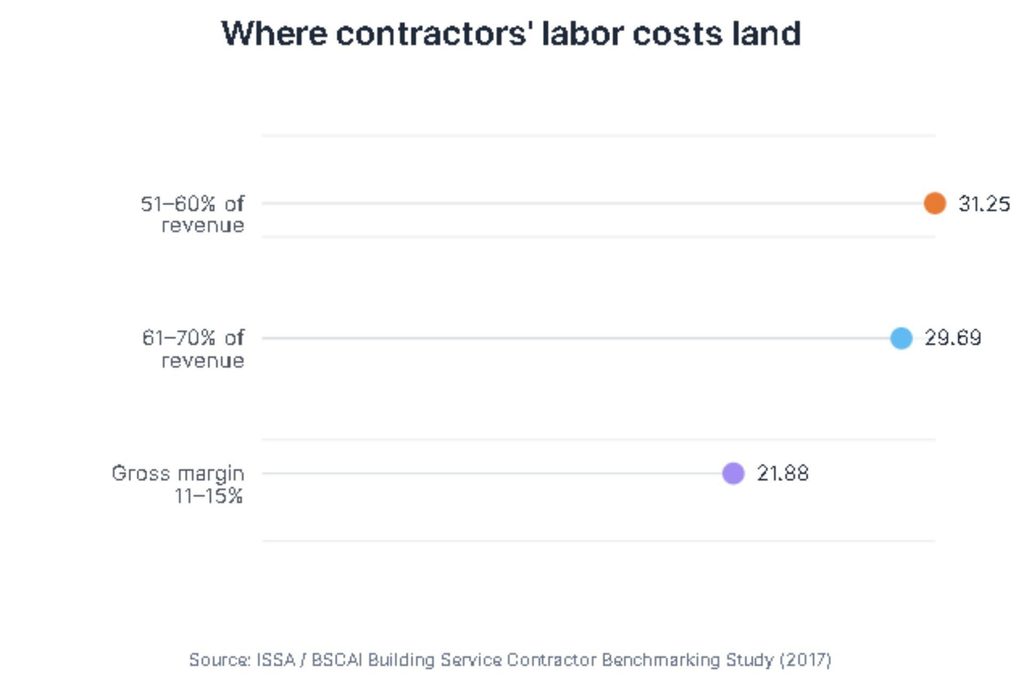
Customer durability is the other half. The ISSA/BSCAI contractor benchmarking study, the 2017 edition and the most recent public one, found 51.56% of surveyed contractors reporting 1% to 5% annual customer attrition, and 40.62% reporting annual employee turnover of 50% or more (ISSA/BSCAI, 2017). The same study found labor cost for hourly field employees at 51% to 60% of revenue for 31.25% of contractors and 61% to 70% for 29.69%, with 21.88% reporting gross margin in the 11% to 15% bracket, the largest single bracket. Those are 2017 brackets, not current medians, but they show how thin the margin is and why a single lost account moves EBITDA.
Phase 3: Key-Man Risk Mitigation: Removing the Founder from Daily Dispatch
A buyer is not purchasing the founder’s phone number. Key-man dependence is the single most common reason a cleaning company prices at the bottom of its band, and the fix is operational: a named operations manager who owns dispatch, a documented account handoff for the top ten clients, and a written escalation path that does not route through the owner. The test is simple. If the founder is unreachable for two weeks, does the schedule hold?
The evidence for why this matters sits in the buyer mix. Financial-backed buyers now take 35% of facility services deals, and those buyers underwrite a platform they can bolt accounts onto, not a personality they have to retain (Sequeira Partners, 2026-01). A business that runs without the founder is a platform asset. A business that runs only with the founder is a job with a client list.
Pro Tip: Document the add-back rationale before the buyer asks. A rejected add-back is a re-trade waiting to happen, and the QoE is where the argument gets settled.
🔗 The California Founder’s Guide to Exiting a 2M-25M Commercial Cleaning & Janitorial Business
The Shield: Protecting Your Crews and Confidentiality
Confidentiality is a decision-grade term, not a courtesy. That mechanism is what protects the night supervisors a competitor would poach and the property managers who might read a sale as a service risk.
The strongest counterargument is that a boutique advisor limits the buyer pool. The deal data does not support it. With 484 facility services transactions announced in 2025, and private equity the most active buyer group, the constraint on a well-prepared cleaning company is not the number of buyers but the number who can close without re-trading (Sequeira Partners, 2026-01). A controlled process with deadlines and comparable bids replaces a first offer’s exclusivity with competitive tension. The firm’s own case study documents an offer of $15M converted to a $20.2M outcome through that process, which is an illustration of the mechanic, not a benchmark any seller should expect.
Buyer selection is the other half of the shield. For a California owner selling a commercial janitorial business, the question is who stays aligned after the honeymoon, not who bids highest on day one.
🔗 The Operations Manager Bottleneck: How Owner-Dependent Dispatching Kills Janitorial Deals
Negotiating the “Non-Financials”
The letter of intent, the LOI, is where the price is agreed and where the terms that actually protect people get written. Four non-financial terms carry most of the weight for a cleaning company, and each one has a statutory or contractual anchor.
| LOI term | What it protects | Anchor |
|---|---|---|
| Benefit parity and COBRA handling | Crews keep coverage through transition | Asset-sale mechanics: employees lose coverage under the seller’s health plan and COBRA notice obligations attach (1800bizbroker, 2026) |
| WARN notice responsibility | Who gives 60 days’ notice, and who pays if it is missed | Cal-WARN caps liability at back pay and benefits up to 60 days or half the days employed, whichever is less (California DIR, current) |
| Severance for tenured ops managers | The people who hold the schedule together | Negotiated term, no statutory floor |
| Brand-name continuity and transition services | Property managers see continuity, not disruption | Negotiated term, tied to the MSA consents |
The WARN thresholds are where mid-size cleaning companies get surprised. California WARN reaches a covered establishment with 75 or more full- and part-time employees in the preceding 12 months, requires 60 days’ written notice before a mass layoff, plant closure or relocation, counts a mass layoff as 50 or more employees in 30 days regardless of workforce percentage, and treats a relocation of 100 or more miles as covered (California EDD, current). Federal WARN reaches employers with 100 or more employees excluding part-timers, and its mass layoff test requires at least 33% of employees and at least 50 employees, or 500 or more (29 U.S.C. § 2101, codified). An employer with 75 to 99 employees is outside federal WARN and inside California’s.
The timing rule catches sellers who assume a sale resets the clock. Notice must be given at least 60 calendar days before a planned plant closing or mass layoff, and where employees are not all terminated on the same date, the first individual termination triggers the requirement (20 CFR 639.5, current). On a sale of the business, the seller’s employees are considered the purchaser’s employees immediately after the effective date, and notice is required only where employees in fact experience a covered employment loss.
Commission is a real cost, and a boutique engagement has to earn it back. The arithmetic is straightforward: on a $12M enterprise value, a two-point improvement in the multiple is $2.4M, which is the frame a steward brings to the fee conversation. The non-financials are where that improvement gets locked in.
🔗 Protecting Your Cleaning Crews: Ensuring Continuity for Your Labor Force Post-Acquisition
Surviving Due Diligence Without Burnout
Diligence burns owners out when the data room is built after the LOI. Deals fail when buyers find something that changes their view of earnings quality, customer durability, contract assignability or compliance exposure, and every one of those four is a pre-market problem, not a diligence problem.
The re-trade objection deserves a direct answer. Practitioners report that 30% to 40% of lower middle market deals are re-traded at least once, typically by 5% to 12% of headline price, though that figure comes from adviser lore rather than a named study, so treat it as a warning about frequency rather than a measured rate (Papermark, 2026). The defense is the same in every case: a documented add-back file, a working-capital peg agreed before the LOI, and a QoE that already survived a skeptical read.
The before-and-after is the argument for the 90 days. Before: a founder-dependent business with handshake accounts and a labor file nobody has audited, priced near the 4.0x commercial median at $2M to $10M revenue. After: recurring contracts with change-of-control clauses, a named operations manager, a clean wage-order record and a sell-side QoE, positioned toward the 5.4x benchmark for the $10M to $25M band (BMI Mergers & Acquisitions, 2026-10-14). The gap between those two outcomes is the work, not the market.
🔗 Surviving “The Day After”: Walking Away from the Operations Board After 30 Years
Architecting Your Next Chapter
The cleaning companies that clear the top of the band are not the biggest ones. They are the ones whose earnings a buyer can verify, whose contracts survive a change of control, and whose crews stay put through the announcement. California’s labor rules raise the cost of getting that wrong, and the PAGA volume data shows the exposure is not theoretical for a 50-to-200-employee shop (California Employment Law Report, 2026-07-31).
The takeaway is that California cleaning business exit planning is a 90-day architecture, not a listing event. Phase 1 finds the labor exposure. Phase 2 converts spot accounts into contracts a buyer can underwrite. Phase 3 removes the founder from dispatch so the business can be valued as an asset. Each phase is owner-manageable, and each one moves the multiple.
The next step is a conversation about which phase your business needs first. Schedule a confidential strategy session with Vinil Ramchandran to walk through your labor file, your contract stack and your dispatch chart before anything goes to market.
🔗 Case Study: How a $12M SoCal Janitorial Founder Protected Their Crews and Secured a Premium Exit
